I still remember the first time a production server melted under me. It was 2014, a modest internal tool built on the framework everyone was praising that year. The traffic spike was nothing dramatic—just a few hundred concurrent users—but the response times climbed, the database connections piled up, and I spent the better part of a night staring at logs that made less and less sense. That night taught me something the documentation never did: choosing among Python web frameworks is less about features and more about the kind of pain you’re willing to live with six months later.
If you’ve ever opened a blank project and felt the quiet pressure of deciding which Python web framework to commit to, this piece is for you. You’ll leave with a clearer sense of how these tools actually behave under real constraints, which trade-offs matter most, and how to avoid the expensive mistakes that still show up in codebases years after the initial decision.
Why the Conversation Around Python Web Frameworks Keeps Shifting
Every few years the community rediscovers the same debate. One camp insists that batteries-included solutions save time. Another argues that minimalism keeps you honest. A third group has already moved on to asynchronous everything and wonders why the rest of us are still talking about request-response cycles.
The truth sits somewhere less tidy. Python web frameworks succeed or fail based on how well they match the shape of the problem in front of you, not on some abstract ranking of “best.” I’ve watched teams burn months forcing a heavyweight framework into a lightweight service, and I’ve watched other teams drown in boilerplate because they refused to accept that some problems actually need structure.
What changes over time is the set of constraints. In the mid-2010s the main pressure was developer velocity and the availability of shared hosting. Today the pressures include cold-start latency in serverless environments, the cost of keeping long-lived connections open, and the sheer volume of JSON that modern APIs exchange. The frameworks that still feel relevant are the ones that adapted without losing their original character.
The Three Mental Models That Actually Matter
When people ask me which of the major Python web frameworks they should learn first, I usually answer with a question of my own: what kind of mental model do you want to carry around?
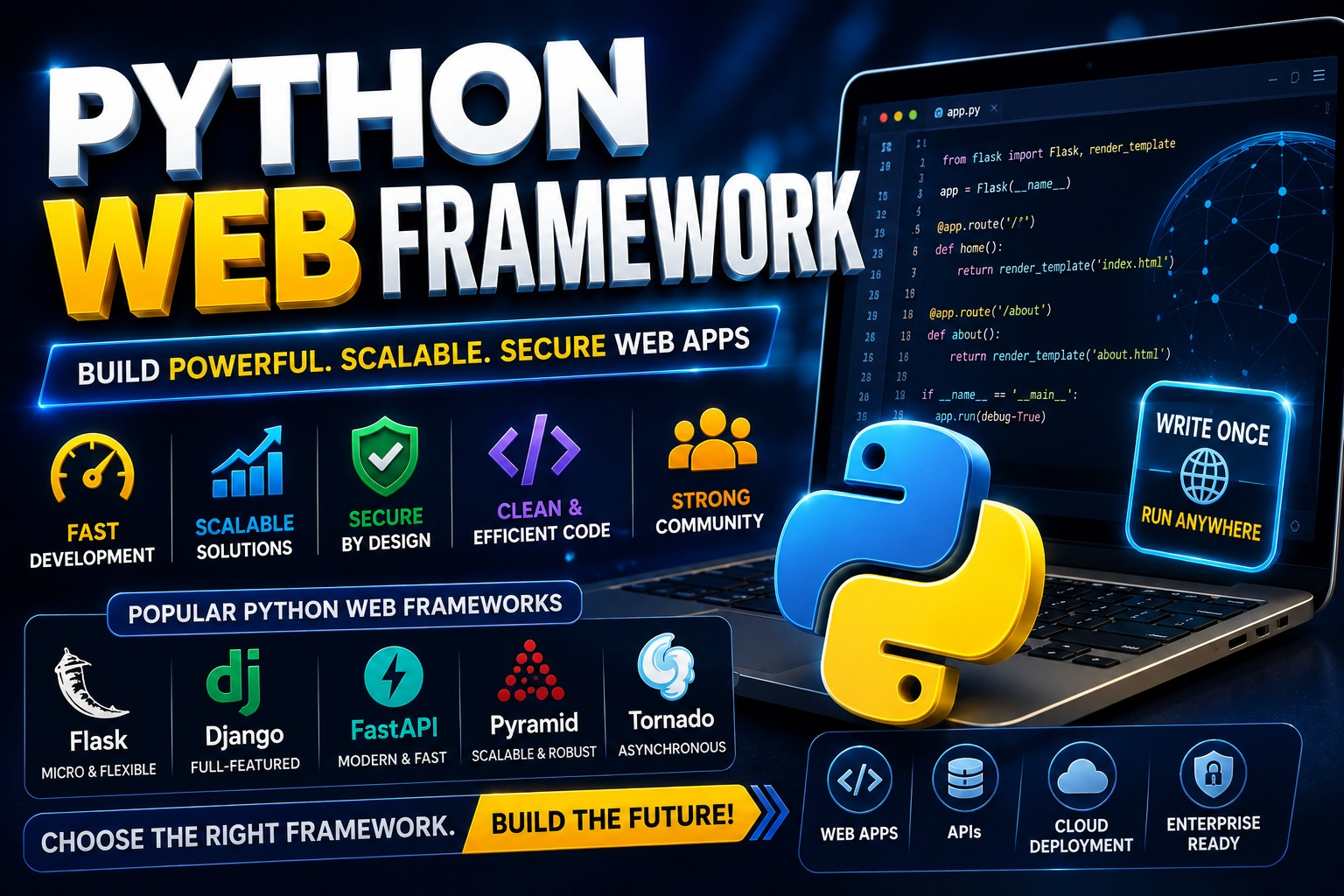
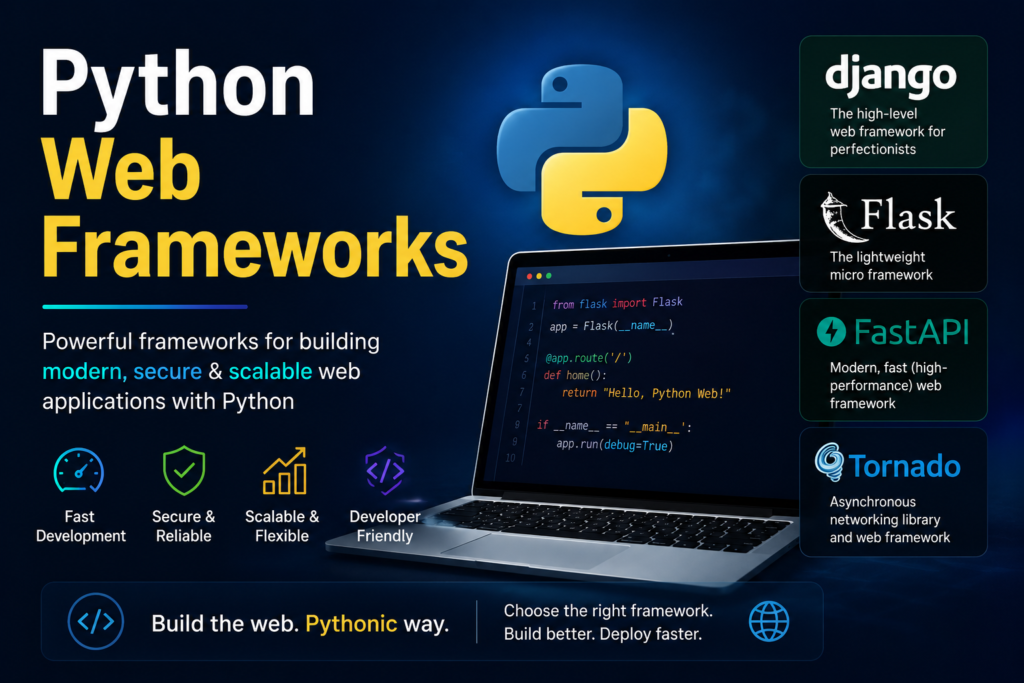
Django still represents the “opinionated application” model. It assumes you are building something that looks roughly like a traditional web application—models, forms, admin, authentication, and a certain amount of ceremony. That ceremony is both its strength and its tax. When the problem fits the shape Django expects, you move startlingly fast. When it doesn’t, you spend energy fighting the framework’s assumptions.
Flask and its spiritual cousins represent the “explicit composition” model. You start with almost nothing and add only what you need. The freedom is real, but so is the responsibility. I’ve seen elegant Flask applications that stayed maintainable for years, and I’ve seen ones that quietly turned into private frameworks no one else could understand. The difference almost always came down to discipline around structure and documentation.
FastAPI and the newer asynchronous frameworks represent a third model that prioritizes performance characteristics and automatic documentation. They feel modern because they lean hard into type hints, Pydantic models, and async/await. For many API-first projects they are genuinely excellent. They are less excellent when the work involves complex server-rendered pages or heavy session state.
None of these models is obsolete. Each still solves real problems cleanly. The mistake is treating them as interchangeable tools rather than different ways of thinking about the same domain.
A Practical Walk Through the Decision Process
Suppose you are starting a new internal tool that will eventually need a public API, some background processing, and a modest admin interface. How do you actually choose?
I begin by listing the non-negotiables. Does the system need to support long-lived WebSocket connections? Is the team already comfortable with type-driven development? Will the same codebase need to serve both browser pages and machine clients? How important is the ability to hire developers who already know the stack?
Those answers usually eliminate at least one major option. If WebSockets and high concurrency are central, the classic synchronous frameworks start looking expensive. If the team is small and needs an admin interface yesterday, the batteries-included approach suddenly looks attractive again.
I also force myself to estimate the cost of being wrong. Switching Python web frameworks mid-project is rarely catastrophic if you kept the business logic cleanly separated from the web layer. It becomes painful when you allowed framework-specific patterns to leak into the domain model. That separation is one of the highest-leverage habits you can develop regardless of which framework you pick.
Common Traps That Still Catch Experienced Teams
One trap I see repeatedly is the premature optimization of the framework choice itself. Teams spend weeks evaluating micro-frameworks, async frameworks, and full-stack frameworks while the actual product requirements are still fuzzy. The evaluation itself becomes a form of productive procrastination. A better approach is to pick the simplest option that can ship the first version, then measure where the real friction appears.
Another trap is treating the framework as a substitute for architecture. I’ve inherited codebases where every endpoint was a thin wrapper around a Django view or a FastAPI route, and the business rules lived nowhere in particular. The framework had become the architecture by default. That works until the day you need to call the same logic from a CLI tool, a background worker, or a second service. Suddenly the web layer is a ball and chain.
A quieter trap is underestimating the operational surface area. Django’s admin is wonderful until you realize you have given non-technical staff the ability to delete critical records with a single click. Flask’s flexibility is wonderful until the deployment story involves six different environment variables and a custom WSGI setup that only one person understands. FastAPI’s automatic OpenAPI schema is wonderful until the schema drifts from the actual behavior because someone started returning raw dictionaries again.
These are not reasons to avoid any particular Python web framework. They are reasons to treat the framework as infrastructure that still requires intentional design.
What the Last Few Years Have Actually Changed
The biggest practical shift has been the normalization of asynchronous code. Even teams that still prefer synchronous frameworks now routinely reach for async libraries for outbound HTTP, database access, and background tasks. The pure async frameworks made that pattern feel first-class. The older frameworks adapted by adding async support without forcing everyone to rewrite everything at once.
Another shift is the rising importance of developer experience around types and documentation. Teams that once accepted loosely typed request and response objects now expect the framework to catch mismatches early. That expectation has pushed even the more traditional Python web frameworks to improve their typing story.
Finally, the deployment landscape has fragmented. Some applications still run on long-lived servers. Others live entirely in short-lived containers or serverless functions. Frameworks that assume a persistent process and a warm application state can feel clumsy in the newer environments. The ones that start quickly and release resources cleanly have an advantage that only becomes obvious after you start paying the cloud bill.
How I Evaluate a Framework in Practice
When I pick up a new Python web framework—or revisit one I haven’t used in a while—I run a short set of experiments rather than reading the marketing page.
I build a small but complete vertical slice: authentication, a couple of related resources, a background task, and an endpoint that talks to an external service. I pay attention to how much code I write that feels like fighting the framework versus working with it. I look at the error messages when I deliberately break things. I check how easy it is to extract the pure business logic and test it without spinning up the entire web stack.
I also look at the community’s actual output. Are the popular extensions still maintained? Do the common “how do I do X” questions have clear, recent answers? Is the documentation written for people who already know the framework or for people who are trying to learn it?
These small tests usually reveal more than any feature comparison chart.
Advice I Wish Someone Had Given Me Earlier
Keep the web layer thin. Whatever Python web framework you choose, treat it as the adapter between HTTP and your actual application. The day you need to expose the same behavior over a different transport, you will be grateful.
Prefer explicit configuration over magic, at least until the magic has proven itself repeatedly. Magic is wonderful when it works and expensive when it doesn’t.
Measure before you optimize the framework choice. Most performance problems I have seen were caused by the database, the external services, or the way the code was structured—not by the framework itself.
Invest in the testing story early. Frameworks that make it easy to test views, routes, and middleware in isolation tend to stay maintainable longer. The ones that force you into full end-to-end tests for every change slowly accumulate fear.
And finally, accept that the “right” choice is temporary. The Python web frameworks ecosystem moves. Requirements change. Teams change. The skill that actually compounds is the ability to keep the important parts of the system independent of whichever framework is currently in fashion.
Closing the Loop
Looking back at that 2014 outage, the framework I was using was not the villain. My incomplete understanding of its connection handling and my failure to load-test realistic traffic patterns were the real problems. The same pattern still shows up today with newer tools. The framework gets blamed, the post-mortem focuses on switching technologies, and the underlying habits remain untouched.
Python web frameworks are mature enough that almost any of the major options can carry a serious application if you respect their design center and keep your own architecture honest. The real leverage comes from matching the tool to the problem, keeping the boundary between framework and domain clean, and treating every choice as reversible until proven otherwise.
The next time you open a blank project and feel that familiar decision fatigue, try starting with the constraints that actually matter instead of the feature list. You may find the choice becomes simpler—and the resulting system more resilient—than any tutorial ever suggested.