

I still remember the first time a friend sent me a link to one of those long, unpolished interviews. No flashy production, just a guy in a simple setup asking hard questions and then shutting up long enough for the guest to actually answer. That was my introduction to Shawn Ryan. Years later, watching the channel climb past six million subscribers and the podcast crack major charts, I keep coming back to the same quiet realization: the money follows the trust. And right now, a lot of people are curious about the practical side of that trust—specifically, what the Shawn Ryan net worth actually looks like.
If you’ve ever wondered how a former SEAL and CIA contractor turned battlefield experience into one of the more independent and lucrative media brands in the podcast world, this piece is for you. We’ll dig into the real drivers behind the numbers, the businesses that matter, the deals that changed the trajectory, and the mindset that keeps the whole thing from becoming just another content machine. No hype. Just the clearest picture available from public reporting, industry patterns, and the visible scale of the operation.
From Small-Town Missouri to Elite Operator
Shawn Ryan didn’t grow up with connections or a silver spoon. Born in Kansas City and raised in Chillicothe, Missouri, he was the kid who played with G.I. Joes, built forts in the woods, and eventually decided the only path that made sense was the hardest one available. He enlisted in the Navy at 18 with one goal: become a SEAL. After making it through BUD/S, he served with SEAL Teams 2 and 8, deploying to places like Haiti and Baghdad during the height of the post-9/11 years.
When the bureaucracy of the Teams started to feel constraining, he left active duty around 2006 and continued the work as a contractor for the CIA’s Global Response Staff. Multiple sources put his total combat-related service at roughly fourteen years and more than twenty deployments across a wide range of operational areas. That stretch of high-intensity, high-risk work left its marks—physical, mental, and relational. Like a lot of guys who spent that much time in the fight, Ryan has spoken openly about the darker periods that followed, including struggles with PTSD and a period of heavy drinking.
The transition out wasn’t smooth. He tried real estate for a stretch. Then, in December 2015, he founded Vigilance Elite. The idea was straightforward: take the practical skills and mindset that kept people alive overseas and teach them to civilians and law enforcement who might one day face an active threat on American streets. Early clients included people preparing for film roles—Keanu Reeves trained with the company ahead of a John Wick installment—and the business slowly found its footing.
The Podcast That Changed the Math
The Shawn Ryan Show didn’t launch as a polished media play. It started as a way to capture real stories from people who had lived them. Early episodes were recorded with limited equipment. The focus stayed on the guest. Ryan’s interviewing style—patient, direct, and willing to sit in uncomfortable silence—stood out in a landscape full of hosts who talk more than they listen.
Growth was steady, then rapid. By 2024–2025 the show was regularly ranking in the top ten on Spotify in the United States. The YouTube channel crossed five million subscribers and has since moved past 6.4–6.5 million, with total views in the multi-billion range. Clips channels amplify the reach further. The audience demographics—predominantly male, relatively high-income, interested in military experience, personal resilience, current events, and alternative perspectives—have proven especially attractive to certain categories of advertisers: tactical gear, supplements, financial services, and mental-health related products.
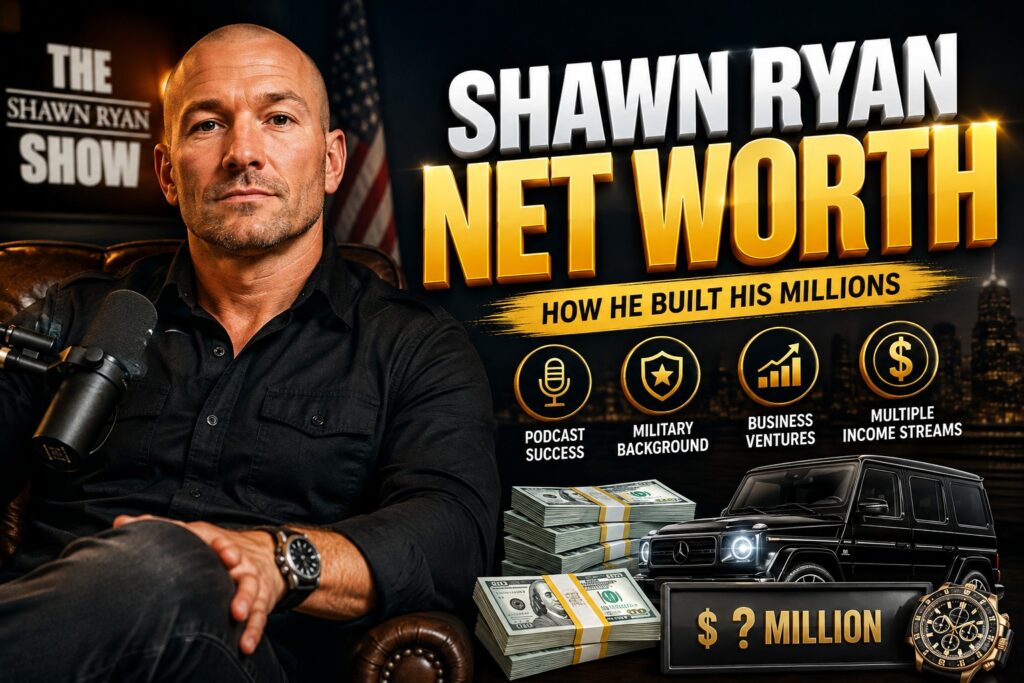
This is where the conversation about Shawn Ryan net worth starts to get concrete. Podcast advertising at premium CPMs, combined with YouTube revenue, membership programs, and brand partnerships, forms the largest current income stream. Public reporting around a 2025 distribution and sales deal with Daylight Media indicated the potential for more than $10 million annually under that arrangement alone—well above the previous minimum guarantee reported with Cumulus. Patreon has also been meaningful; one account from the show’s operating side put paid membership numbers in the tens of thousands at a base tier of $5 per month, generating seven-figure annual revenue even before higher tiers or one-time contributions.
Vigilance Elite continues to contribute through training courses, merchandise (apparel, gear, and various branded products), and related consulting. The company has also taken minority stakes in complementary businesses in exchange for promotion, another quiet way of building equity alongside cash flow.
Estimating the Shawn Ryan Net Worth
No public company filings or audited statements exist, so every figure is an estimate. Conservative public analyses in 2025 placed the range roughly between $6 million and $8.5–10 million. More optimistic assessments that model higher podcast advertising revenue, the Daylight Media upside, ongoing YouTube growth, and the cumulative value of the brand have suggested $20 million to $40 million as of 2026. The truth almost certainly sits somewhere in between and continues to move upward with each successful year of scaled operations.
What matters more than any single number is the structure. The Shawn Ryan net worth is not the result of one lucky viral moment or a single network deal that traded creative control for a big check. It is the product of owning the intellectual property, controlling the relationship with the audience, and layering multiple revenue streams that reinforce each other. Advertising pays the bills and funds better production. Memberships create direct connection and more predictable income. Training and merch turn brand affinity into tangible products. Equity stakes in related companies create longer-term upside.
This multi-channel approach is increasingly common among the most successful independent creators, but Ryan executed it with unusual discipline. He has repeatedly emphasized a long-game perspective—building something that can eventually run with less personal time spent on every episode rather than maximizing short-term extraction.
Practical Lessons from the Build
Anyone trying to understand the Shawn Ryan net worth story can pull useful principles without needing a special-operations background.
First, audience trust compounds faster than production value. Early episodes were not slick. The consistency of tone and the quality of the conversations mattered more. Second, vertical ownership protects economics. By keeping the show independent and later partnering on terms that preserved creative control and ownership, Ryan avoided the common trap of trading long-term equity for short-term distribution. Third, adjacent businesses that feel authentic to the core audience—tactical training, veteran-focused products, mental-health initiatives—convert attention into revenue more efficiently than random sponsorships.
There are also clear risks worth noting. Heavy reliance on a single host’s presence creates key-man risk. The political and cultural positioning of some guests invites criticism and potential advertiser caution. Scaling a lean operation into a larger media business requires hiring and systems that can dilute the original intimacy if handled poorly. Ryan has spoken about wanting to reduce episode frequency over time and bring in stronger operational leadership precisely to manage these pressures.
Personal Life and Values Behind the Numbers
Public details about Ryan’s private life remain limited by design. He is married and has spoken about the challenges of reintegrating after years of deployment. In recent years he has put energy into veteran mental-health causes, including joining the board of a technology company focused on earlier detection and support for service members and veterans. That work is consistent with the same through-line visible in the podcast: telling difficult truths and trying to reduce the isolation that too many operators carry.
The Shawn Ryan net worth, in that sense, is secondary. The primary asset has always been the ability to sit across from someone who has lived an extreme life and draw out the version of the story that rarely makes it into official histories or polished media appearances. The financial results followed because enough people valued that access enough to watch, listen, subscribe, and buy.
Looking Ahead
As of mid-2026 the operation continues to expand. A larger studio facility has been discussed. New partnerships and product lines appear regularly. The Daylight Media relationship provides professional ad sales and distribution muscle while leaving ownership intact. Whether the net worth lands closer to the lower or higher published estimates in any given year matters less than the trajectory: a former operator who left the shadows, built a platform around authenticity, and turned it into a durable independent media business.
For readers tracking creator economics or simply curious about how certain public figures actually make money, the Shawn Ryan net worth offers a useful case study. It is not the product of overnight fame or inherited advantage. It is the slower, less glamorous result of consistent output, careful ownership decisions, and an audience that keeps showing up because the conversations still feel real.
If you’re building something yourself—podcast, training business, or any audience-driven project—the practical takeaway is straightforward. Protect the relationship with the people who trust you. Own as much of the value chain as you can. Layer revenue streams that make sense to your specific audience. And remember that the numbers only stay healthy as long as the core product remains something people actually want to spend time with. That formula has worked remarkably well for Shawn Ryan so far.