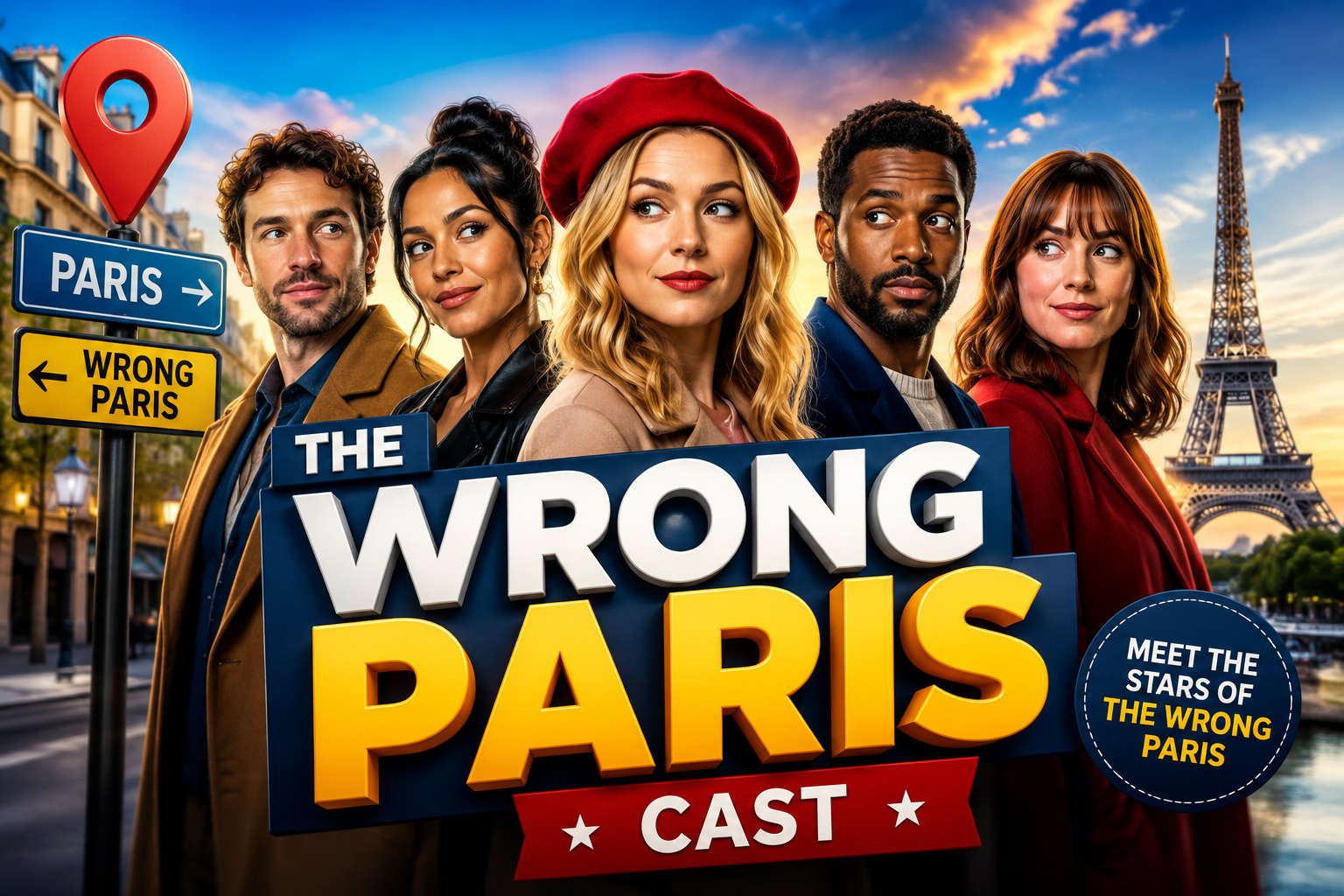
You’ve probably had that moment. You’re scrolling Netflix late at night, looking for something light, and a title jumps out that promises pure escapism. You click, settle in, and within the first ten minutes realize the people on screen are doing more than just hitting their marks. They’re making the whole thing feel lived-in. That happened to me with The Wrong Paris. I went in expecting another formulaic rom-com. I stayed because of the wrong paris cast.
The film follows Dawn, a young Texas artist who joins what she believes is a dating show filmed in Paris, France, only to discover she’s landed in Paris, Texas. It’s a classic bait-and-switch premise, the kind that could easily tip into pure silliness. What keeps it grounded is the ensemble. The wrong paris cast doesn’t just deliver the expected charm. It layers in unexpected texture, chemistry that feels unforced, and supporting turns that refuse to stay in the background. If you’re the kind of viewer who watches rom-coms for the people as much as the plot, this one rewards that habit.
By the end of this piece you’ll know exactly who makes the film work, why their previous work matters here, and what the casting choices reveal about how Netflix is currently approaching feel-good movies. You’ll also walk away with a clearer sense of what separates a forgettable streaming romance from one you actually recommend to friends.
The Core Pairing That Carries Everything
At the center sits Miranda Cosgrove as Dawn. Most people still connect her with Carly Shay or Megan Parker, those sharp, quick-talking teen roles that defined a generation of Nickelodeon. Watching her step into a more adult lead feels like watching someone finally get the room to breathe. Dawn needs money for art school in the real Paris. She is practical, a little guarded, and not especially interested in the bachelor at first. Cosgrove plays the reluctance without turning it into broad comedy. You see the calculation in her eyes when she realizes the show is a setup, and you also see the gradual softening when genuine connection appears.
Opposite her is Pierson Fodé as Trey McAllen, the cowboy bachelor at the heart of the fictional dating show The Honeypot. Fodé has the physical presence for the role—tall, easy smile, the kind of face that looks natural under a cowboy hat—but he doesn’t lean only on that. There’s a quiet steadiness to his performance that keeps Trey from becoming a cardboard romantic lead. The early scenes between Cosgrove and Fodé matter more than the big romantic beats later. Their first real conversation has a slight awkwardness that feels earned rather than manufactured. That small note of realism is what makes the later chemistry land.
I kept thinking about how many rom-coms fumble the central pairing by casting purely for name recognition or conventional good looks. The wrong paris cast avoids that trap. Cosgrove and Fodé had worked in the same orbit years earlier—he appeared in an episode of iCarly—but they don’t rely on nostalgia. They build something specific to this story.
The Rival Who Refuses to Stay One-Note
Madison Pettis plays Lexi, the influencer contestant who arrives ready to win. On paper she is the classic antagonist: polished, strategic, willing to undercut the quieter girl. Pettis has the résumé for it—Disney Channel roots, The Game Plan, later turns in more adult projects—but she keeps Lexi from becoming pure cartoon. There’s a flicker of insecurity underneath the confidence, a sense that Lexi is performing the role of “the one to beat” as much as anyone else on the show. That small humanizing choice pays off in the group scenes. When the women interact, the energy feels competitive without tipping into pure mean-girl territory.
The wrong paris cast benefits from this restraint. Rom-coms often stack the deck so heavily in favor of the heroine that the rival becomes background noise. Here, Lexi has enough presence that her scenes with Dawn actually raise the temperature. You understand why the producers keep both women around. The dynamic works because neither actress is trying to outshine the other. They simply occupy different wavelengths and let the script do the rest.
Supporting Players Who Steal Quiet Moments
Frances Fisher as Birdie, Dawn’s grandmother, brings the kind of grounded warmth that veterans often deliver in these projects. Fisher has been doing this for decades—sharp, no-nonsense maternal figures who still feel fully human. Birdie is not a plot device. She has opinions, history, and a clear emotional stake in Dawn’s choices. When she appears, the film briefly stops feeling like a dating-show satire and starts feeling like a family story.
Yvonne Orji as Rachel, one of the producers, injects a different kind of energy. Orji knows how to land a line with just enough edge to make you lean in. Her character sees potential in Dawn that Dawn herself may not fully recognize yet. That observation becomes a quiet through-line. The wrong paris cast uses Orji’s natural charisma to keep the behind-the-scenes machinery of the reality show feeling alive rather than purely cynical.
Then there is the broader ensemble of contestants and crew. Madeleine Arthur, Christin Park, Hannah Stocking, Torrance Coombs, and others fill out the house and the production team. None of them feel like filler. A scientist roommate, a former beauty queen, a contestant with very specific life goals—these details give the group scenes texture. You start to track individual personalities instead of treating the other women as a single unit. That is harder to pull off than it looks, and the wrong paris cast makes it look easy.

Why This Ensemble Works Better Than It Should
Casting a Netflix rom-com is a particular art. The platform wants recognizable faces that will travel internationally, yet the stories often demand a lighter touch than prestige drama. The wrong paris cast threads that needle. Cosgrove brings built-in goodwill from years of likable roles without being so massive that the movie becomes about her star power. Fodé has the leading-man looks and enough prior work to feel solid. The supporting players arrive with enough television and film credits that the world feels populated by real people rather than types.
Director Janeen Damian has a track record with this kind of material. She knows how to keep the tone buoyant without letting it float away. The script by Nicole Henrich gives the actors clear emotional jobs: Dawn needs to choose between a long-held dream and an unexpected connection; Trey needs to decide whether the show’s manufactured romance can become something real; the other contestants need to remain distinct while still serving the central story. The wrong paris cast delivers on those jobs without overreaching.
One of the quieter strengths is how the film handles the Texas setting. Paris, Texas is not treated as a joke location. The local color, the ranch, the small-town texture all feel specific. The actors sell the place as much as the romance. That sense of location is easy to underestimate, yet it is part of why the central pairing feels plausible. Dawn is not just falling for a handsome stranger. She is reconsidering what home and ambition look like when they collide.
Lessons From the Chemistry and the Choices
Watching the wrong paris cast, a few practical observations stand out for anyone who cares about how these movies get made.
First, prior familiarity between actors can help, but it is not required. Cosgrove and Fodé had crossed paths years earlier, yet the real work happened on set. The director has spoken about their immediate click. That kind of organic connection cannot be forced in the casting office, but it can be protected once it appears. Protecting it means giving the actors room to find the smaller moments—the hesitation before a confession, the shared glance during a group challenge—instead of rushing every beat toward the big romantic payoff.
Second, rivals work better when they are allowed complexity. Lexi could have been pure obstacle. Instead she has her own reasons and her own vulnerability. That choice elevates the entire competition structure. Viewers are more invested when they understand both sides.
Third, veteran supporting actors remain invaluable. Fisher and Orji do not need long scenes to make an impression. They arrive with the weight of previous strong work and simply do the job. In an era of ensemble-heavy streaming titles, that reliability is worth more than another big name who might overshadow the story.
Finally, the wrong paris cast shows the value of filling the house with distinct voices. Reality-show satires often collapse the other contestants into one loud group. Here, the women have individual stakes and individual personalities. That makes the group dynamics funnier and more interesting. It also makes Dawn’s growth clearer because you can measure it against the people around her.
What the Audience Actually Gets
If you come to The Wrong Paris looking for pure comfort viewing, the cast delivers. The central romance is warm without being sticky. The humor stays mostly character-based rather than relying on broad physical gags. The Texas setting has enough personality that the film never feels like it could have been shot on any generic backlot.
If you come looking for something a little sharper, the casting still holds up. The wrong paris cast understands that a good rom-com needs more than two attractive leads trading banter. It needs a sense of community, of competing desires, of people who might still be interesting after the credits roll. This ensemble provides that.
I have watched enough of these movies to know when the chemistry is being manufactured in the edit and when it was present in the room. The wrong paris cast falls into the second category. That is the difference between a title you finish and forget and one you find yourself thinking about the next day.
Closing Thought
The next time a Netflix rom-com lands in your recommendations, pay attention to more than the premise. Look at who is actually carrying the story. In this case, the wrong paris cast turns a solid concept into something more memorable. Cosgrove, Fodé, Pettis, Fisher, Orji, and the rest of the ensemble make the detour to Paris, Texas feel worth the trip. Sometimes the smartest casting choice is the one that trusts the actors to find the human notes underneath the high concept. This group did exactly that.