I remember sitting in the theater, heart pounding, as the credits rolled on Weapons. The audience was dead silent for a beat, then erupted into a mix of gasps, nervous laughs, and whispers. That final sequence—chaotic, visceral, and strangely cathartic—left everyone reeling. If you’ve walked out of the theater (or finished streaming it) wondering what the hell just unfolded, you’re not alone. This deep dive into the weapons movie ending explained will unpack the twists, the metaphors, and the lingering emotional scars that make Zach Cregger’s follow-up to Barbarian such a gut-punch.
By the time the lights came up, one thing was clear: this wasn’t just another horror flick about missing kids. It was a brutal meditation on family betrayal, childhood trauma, and the monsters we invite into our homes. Stick around, because we’re going beyond the surface spoilers to explore why the weapons movie ending explained resonates so deeply and what it says about the stories we tell ourselves to survive.
The Setup: A Town Haunted by One Ordinary Night
Weapons opens with the voice of a young girl narrating events from two years earlier in the quiet town of Maybrook. Seventeen children from the same classroom vanish at the exact same moment one night. No signs of struggle at first. Just empty beds and parents losing their minds. The film follows a handful of interconnected stories—particularly young Alex, whose home becomes ground zero for the nightmare, and the desperate parents searching for answers.
What starts as a missing persons mystery quickly spirals into something far darker. Cregger masterfully builds dread through everyday horrors: strained marriages, small-town gossip, and the quiet realization that the adults who are supposed to protect us might be the least reliable ones of all. By the midpoint, we meet Aunt Gladys, the unassuming relative who’s overstayed her welcome in Alex’s house. She’s not just eccentric—she’s feeding on the life force of those around her, turning loved ones into literal weapons.
This is where the weapons movie ending explained conversation really kicks off. The children aren’t simply kidnapped. They’re being weaponized through dark rituals involving personal belongings—hair, trinkets, pieces of their lives—bound to a twisted totem. Gladys uses them like extensions of her will, draining them to sustain her own power while forcing Alex to assist her.
Breaking Down the Climax: Turning the Tables on the Witch
Let’s get into the meat of the weapons movie ending explained without holding back. In the final act, everything converges on Alex’s house. Justine and Archer, two parents pushed to their limits, storm in looking for their kids. What they find is a house of horrors: bewitched adults, a basement full of trance-like children, and Gladys at the center of it all, pulling the strings.
The confrontations are brutal. Bewitched neighbors Paul and James become violent obstacles. Archer falls under Gladys’s spell and turns on his ally. It’s raw, chaotic, and brilliantly shot—handheld camera work that makes you feel the panic in every frame. But the real turning point belongs to Alex.
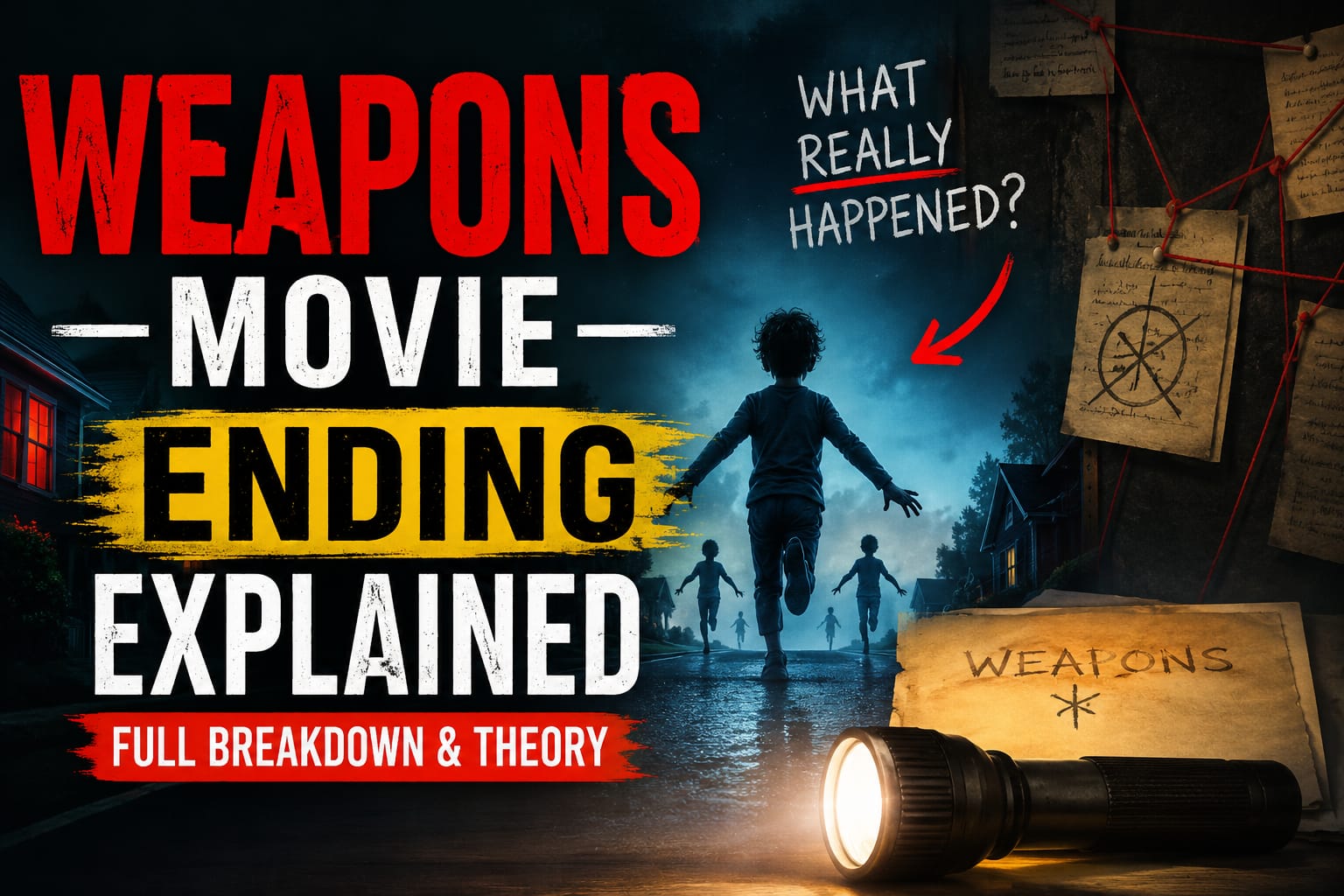
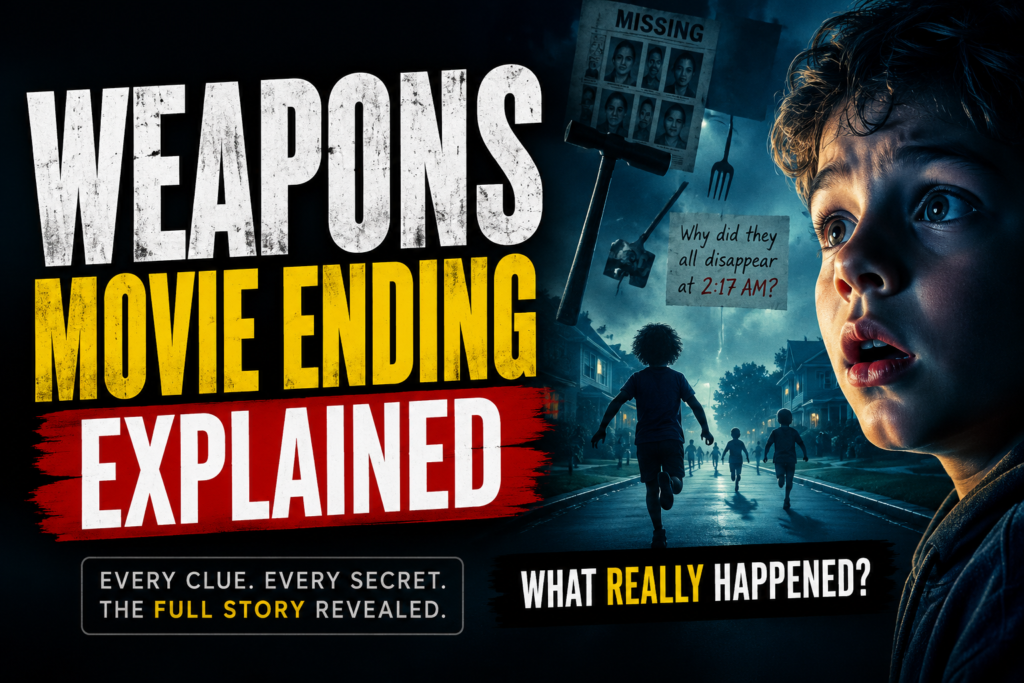
This kid, who’s been manipulated and terrified throughout the film, finally snaps. He grabs Gladys’s own ritual stick, the one primed with his classmates’ belongings, and adds a piece of her hair from her brush. In one clever, desperate move, he flips the script. The children awaken not as victims, but as a vengeful horde. They chase Gladys through the neighborhood in a sequence that’s equal parts terrifying and darkly hilarious. When they finally catch her on a suburban lawn, they tear her apart—limb from limb, like a pack of feral animals exacting justice.
It’s one of the most memorable villain deaths in recent horror. The weapons movie ending explained here isn’t just about the gore (though there’s plenty). It’s about agency. The very tools Gladys used to control and harm become the instruments of her downfall. Alex doesn’t need an adult savior; he saves himself and his friends by understanding the monster’s own rules.
The Bittersweet Aftermath: Not Everyone Gets a Happy Ending
Here’s the part that stings in any solid weapons movie ending explained discussion: victory comes at a devastating cost. Gladys’s death breaks her spells, but the damage is done. Most of the children, including Archer’s son Matthew, are left catatonic—alive but hollowed out, staring blankly at the world. Alex’s parents, who were under her influence far longer, end up institutionalized, essentially “dead inside” despite their bodies persisting.
The narration returns in the closing moments, delivered by that same young voice. Some kids slowly begin to recover and speak again over time. Alex finds a kinder relative to live with. Archer carries his silent son home. There’s no sweeping resolution, no group hug that erases the trauma. Just quiet survival.
This unresolved pain is what elevates Weapons above typical genre fare. Cregger isn’t interested in tidy closure. He wants us to sit with the reality that some wounds never fully heal, especially when the betrayal comes from within the family circle.
Themes That Linger: Family, Trust, and the Weapons We Become
Digging deeper into the weapons movie ending explained reveals rich layers. Gladys isn’t a cartoonish evil witch—she represents the insidious ways toxic relatives can embed themselves in our lives, draining emotional and literal vitality. The children as “weapons” serve as a powerful metaphor for how trauma gets passed down, how innocence can be co-opted into tools of destruction.
Think about it: Alex is forced to betray his classmates to protect his bewitched parents. The adults, blinded by denial or desperation, fail repeatedly to see the danger right in front of them. Only the kids, working together in that final rampage, manage to break the cycle. It’s a stark message—“The adults won’t save you, but you can save each other.”
Cregger, coming off the success of Barbarian, doubles down on subversive horror. He blends supernatural elements with grounded family drama, making the weapons movie ending explained feel both fantastical and painfully relatable. How many of us have dealt with a relative who overstays, manipulates, or quietly erodes the household? The film amplifies that to supernatural extremes, but the emotional truth hits home.
Why the Ending Works (And What It Means for Horror Fans)
One of the smartest choices in the weapons movie ending explained is the tonal balance. The child horde chase scene could have been pure terror, but the dark comedy—Gladys sprinting for her life, the audience laughing through their discomfort—makes it unforgettable. It’s cathartic without being cheap. Horror needs moments like this: release valves that acknowledge the absurdity of our fears while still honoring the stakes.
For filmmakers and storytellers, there’s a lesson here too. Build your mythology carefully, then subvert expectations with character-driven payoffs. Alex’s resourcefulness isn’t a deus ex machina; it’s earned through his quiet observations of Gladys’s rituals. The weapons movie ending explained succeeds because every twist feels rooted in the characters’ pain and ingenuity.
If you’re a fan of smart horror, rewatch with an eye on the small details: the way personal items are used in the rituals, the subtle shifts in Gladys’s demeanor, and the narrator’s perspective that frames everything with hindsight. These elements reward multiple viewings and fuel endless online debates.
Practical Takeaways for Viewers and Aspiring Storytellers
- Pay attention to setup details. The weapons movie ending explained feels satisfying because clues are planted early without being obvious.
- Embrace moral gray areas. Not every hero emerges unscathed, and not every villain is pure evil. Gladys is monstrous, but her methods exploit real human vulnerabilities.
- Balance horror with humanity. The film’s emotional core—parental love twisted into something destructive—makes the supernatural elements land harder.
- Avoid over-explaining. The ending leaves questions unanswered (Are there other witches? Will the kids fully recover?), which invites audience investment rather than frustration.
Mistake to avoid: treating your audience like they need every thread tied up neatly. Sometimes the scar tissue is the point.
Final Thoughts on the Weapons Movie Ending Explained
Weapons isn’t perfect—some pacing dips in the middle, and a few supporting characters feel underdeveloped—but its climax and resolution more than make up for it. The weapons movie ending explained boils down to this: evil can hide in plain sight, often wearing the face of family. But resilience, cleverness, and collective rage can still overcome it, even if the victory tastes bittersweet.
Next time you watch it, notice how the ordinary suburban setting amplifies the terror. A lawn littered with the remains of a witch feels both ridiculous and profoundly disturbing. That’s the magic of Cregger’s approach.
If this weapons movie ending explained helped untangle your thoughts or sparked new ones, drop a comment below. What did you think of that final chase? Did the catatonic aftermath hit you as hard as it did me? Horror thrives on these conversations, and films like Weapons remind us why we keep coming back to the dark—because sometimes, understanding the monster helps us face our own.