
Have you ever looked at the clock and wondered exactly what time was it 5 hours ago? This simple question comes up more often than you might think. Whether you are tracking work hours, planning a meeting across time zones, checking when a live event started, or just trying to remember something that happened earlier in the day, knowing how to find what time was it 5 hours ago can be surprisingly useful.
People search for “What Time Was It 5 Hours Ago” because time moves quickly and our memory is not always perfect. In a busy world filled with schedules, shifts, flights, and digital notifications, the ability to quickly subtract five hours from the current time helps keep everything organized. Calculating past time is a basic life skill that supports better planning at home, at work, during travel, and even in online activities. From students managing study sessions to professionals handling global teams, understanding what time was it 5 hours ago makes daily life smoother and more accurate.
This guide walks you through everything you need to know. You will learn the meaning of the question, how the calculation works, real-life uses, step-by-step methods, common mistakes, and future trends in time tools. By the end, you will be able to answer “What Time Was It 5 Hours Ago” confidently no matter what the current time is.
What Time Was It 5 Hours Ago?
Definition
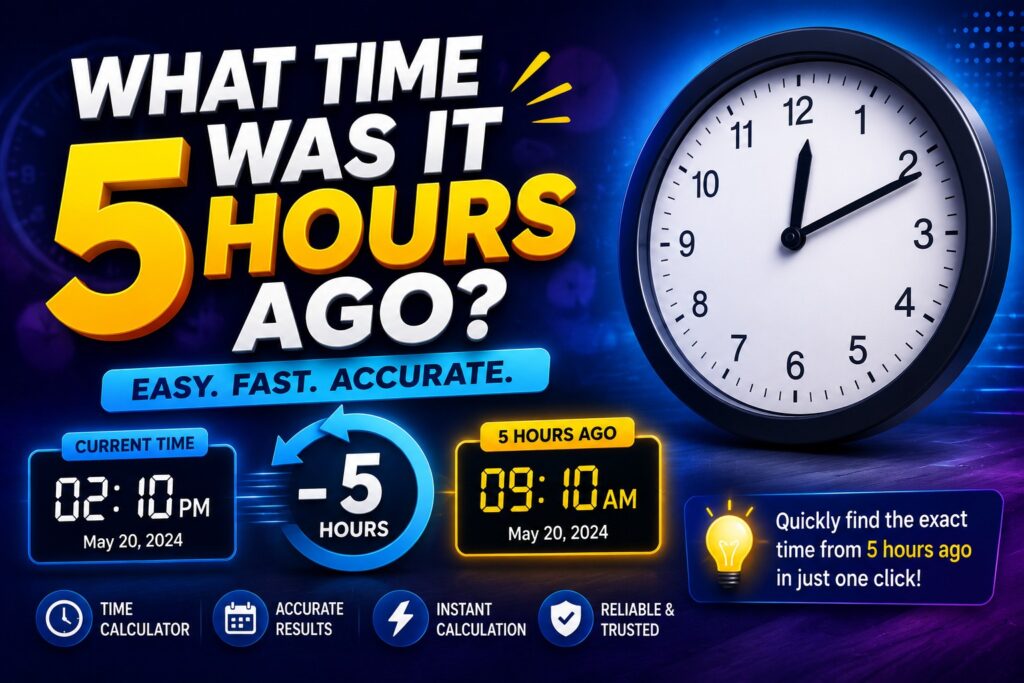
“What Time Was It 5 Hours Ago” is a straightforward request to subtract five hours from the present moment. If the clock now shows 3:00 PM, then five hours earlier it was 10:00 AM. The phrase is commonly typed into search engines or time calculators when someone needs a quick answer without doing the math themselves.
Why People Search for “What Time Was It 5 Hours Ago”
People search for this phrase for many practical reasons. Some forget the exact start of a task or conversation. Others need to convert times for international colleagues. Shift workers often check back to see when their previous shift ended. Parents might want to know when a child’s medicine was last given. Gamers and streamers look up event start times. Travelers calculate local times after long flights. In short, the search reflects a universal need for reliable time awareness.
Common Situations Where This Calculation Is Useful
Everyday life is full of moments that require looking five hours into the past. A remote worker might ask what time was it 5 hours ago to log hours correctly. A traveler arriving in a new city may need to adjust for jet lag and figure out previous local times. Students tracking study blocks or athletes monitoring training sessions also benefit. Even something as simple as remembering when a package was delivered or when a favorite show aired can lead someone to search for what time was it 5 hours ago.
Importance of Time Calculations in Daily Life
Accurate time calculations keep schedules on track and reduce stress. Knowing what time was it 5 hours ago helps prevent double-booking, missed medication, or confusion about deadlines. In professional settings it supports fair shift tracking and meeting coordination. In personal life it improves planning and memory. Mastering this basic skill builds confidence with larger time-management tasks.
Key Features of “What Time Was It 5 Hours Ago”
Simple Time Calculation
The core idea is pure subtraction. No advanced formulas are required. Anyone who can count backward on a clock face or digital display can solve “What Time Was It 5 Hours Ago.”
Instant Results
Online tools and smartphone clocks deliver the answer in seconds. Type the current time or simply ask, and the result appears immediately.
Works with Any Current Time
Whether it is 9:17 AM, 2:45 PM, or 11:30 PM, the same method applies. The calculation adapts to whatever the clock currently shows.
Useful Across Different Time Zones
When traveling or working with international teams, converting five hours earlier in one zone and then adjusting for the destination zone becomes easy once the basic subtraction is clear.
Helpful for Scheduling and Planning
Planners, calendars, and to-do apps all benefit from accurate past-time awareness. Knowing what time was it 5 hours ago helps refine future schedules.
Compatible with Digital Clocks and Online Calculators
Modern devices make the process effortless. Digital clocks, phone assistants, and dedicated hours-ago calculators all support the same simple request.
How “What Time Was It 5 Hours Ago” Works
Step-by-Step Explanation
- Note the current hour and minutes.
- Subtract five from the hour.
- Keep the minutes the same unless you also need to adjust for minutes.
- Adjust for AM/PM or the 24-hour format if the result crosses midday or midnight.
- Confirm the day if the subtraction moves into the previous calendar day.
How to Subtract Five Hours from the Current Time
Start with the hour number. If the current hour is 8, five hours earlier is 3. If the current hour is 2, five hours earlier is 9 of the previous half-day cycle. Minutes stay unchanged in a pure five-hour subtraction.
Examples Using Different Times
- Current time 4:30 PM → What time was it 5 hours ago? 11:30 AM
- Current time 9:15 AM → What time was it 5 hours ago? 4:15 AM
- Current time 1:00 AM → What time was it 5 hours ago? 8:00 PM the previous day
- Current time 7:45 PM → What time was it 5 hours ago? 2:45 PM
Understanding AM and PM
AM covers midnight to just before noon. PM covers noon to just before midnight. Crossing noon or midnight requires switching the designation. For example, subtracting five hours from 2:00 AM lands in the previous evening’s PM.
Simple Explanation of 24-Hour Time Format
In 24-hour format (military time), hours run from 00:00 to 23:59. Subtracting five is often easier because there is no AM/PM switch. 14:00 minus five hours is 09:00. 03:00 minus five hours is 22:00 of the previous day.
Benefits of Using “What Time Was It 5 Hours Ago”
Saves Time
Instead of guessing or counting on fingers, a quick calculation or tool gives the exact answer in seconds.
Improves Scheduling Accuracy
Accurate past times lead to better future plans. Meetings, deadlines, and personal routines all benefit.
Helpful for Work Shifts
Employees and managers can verify start and end times, overtime, and break periods with confidence.
Useful for Travel Planning
Jet lag, connecting flights, and local event times become clearer when you can quickly determine what time was it 5 hours ago in different locations.
Assists with Event Tracking
Live broadcasts, sports games, webinars, and online launches often require looking back five hours to confirm start times or missed segments.
Easy for Students and Professionals
Both groups deal with deadlines, study blocks, client calls, and project timelines. The simple skill of answering “What Time Was It 5 Hours Ago” supports better organization.
Popular Uses of “What Time Was It 5 Hours Ago”
Tracking Work Hours
Many people need to log the exact start of a task. Knowing what time was it 5 hours ago helps complete timesheets accurately.
Calculating Time Differences
When comparing two moments five hours apart, the same subtraction method provides the foundation for larger difference calculations.
Scheduling Meetings
If a colleague in another city asks about availability, calculating five hours earlier helps align calendars quickly.
Flight and Travel Planning
Arrival times, layover durations, and local schedules often require looking backward five hours to understand the full journey.
Online Gaming Events
Game launches, raids, and tournaments frequently start at fixed server times. Players check what time was it 5 hours ago to see if they missed the beginning.
Live Broadcasts
Television shows, sports, and streaming events may have already begun. Viewers use the calculation to decide whether to catch the remaining portion or watch a replay.
Medical Reminders
Medication schedules, therapy sessions, and health logs benefit from precise past-time records.
Daily Planning
From meal times to exercise routines, knowing what time was it 5 hours ago helps refine the rest of the day’s agenda.
How to Calculate What Time Was It 5 Hours Ago
Manual Calculation
Look at a clock or write down the current time. Subtract five from the hour. Adjust AM/PM or the date if necessary. Practice a few examples until the process feels automatic.
Using a Smartphone
Most phones have a clock or calculator app. Some allow voice commands such as “What time was it five hours ago?” Digital assistants can answer instantly.
Using a Digital Clock
Many digital clocks display both 12-hour and 24-hour formats. Switching to 24-hour mode can make subtraction simpler.
Using an Online Time Calculator
Search for an hours-ago calculator or time difference calculator. Enter the current time and select “5 hours ago.” The tool returns the result immediately and often handles time zones automatically.
Tips for Beginners
- Always double-check AM/PM.
- Practice with both 12-hour and 24-hour formats.
- When crossing midnight, remember the date also changes.
- Keep a simple mental rule: five hours is one-fifth of a day.
- Use reliable online tools when precision matters.
Pros and Cons
Pros
- Quick and easy
- No advanced math required
- Useful in everyday situations
- Accurate when calculated correctly
Cons
- Time zones can cause confusion
- Daylight Saving Time changes may affect calculations
- AM/PM mistakes are common
Common Issues and Troubleshooting
Confusing AM and PM
Solution: Convert the time to 24-hour format temporarily, subtract, then convert back. Or say the full phrase “two in the afternoon” instead of relying only on the letters.
Crossing Midnight
Solution: When the result is earlier than midnight, subtract the remaining hours from 12 or 24 and mark it as the previous day. Example: 2:00 AM minus five hours is 9:00 PM yesterday.
Time Zone Differences
Solution: First calculate what time was it 5 hours ago in your current zone, then apply the known offset for the other location. Online converters can do both steps at once.
Daylight Saving Time Changes
Solution: Check whether the five-hour window includes a DST transition. In most cases the clock jumps forward or back by one hour, so adjust the final result by that extra hour if needed.
Incorrect Manual Calculations
Solution: Write the current time and the target time side by side. Count the hours on a clock face or use your fingers. Verify with a second method such as a phone calculator.
Future of Time Calculation Tools
AI-Powered Time Assistants
Future tools will understand natural language even better. You will simply say “What time was it 5 hours ago in Tokyo?” and receive a precise answer that already accounts for local rules.
Smart Scheduling Tools
Calendars will automatically suggest optimal meeting times by calculating past and future offsets in the background.
Voice-Controlled Time Calculations
Smart speakers and wearables will answer “What Time Was It 5 Hours Ago” without requiring a screen.
Better Calendar Integration
Apps will link past events, time-zone data, and personal routines so that five-hour look-backs become part of larger planning insights.
Future Improvements in Digital Time Management
Expect tighter connections between clocks, health apps, travel platforms, and work software. The simple act of asking what time was it 5 hours ago will feed into smarter recommendations for rest, productivity, and coordination.
Conclusion
Being able to determine what time was it 5 hours ago is a small but powerful skill. It supports accurate work logs, smoother travel, better event tracking, and clearer daily planning. Whether you subtract the hours manually, ask your phone, or use an online time calculator, the process remains simple and reliable.
The next time you need to look five hours into the past, you now have multiple methods at your fingertips. Practice the manual calculation, explore a trusted hours-ago calculator, and stay aware of time-zone and Daylight Saving details. With these tools you can answer “What Time Was It 5 Hours Ago” instantly and correctly whenever the question arises.
Start using these techniques today. Open your clock app or a reliable online calculator and try a few examples. The more you practice, the more natural the calculation becomes—and the better organized your days will feel.