
Understanding Concave vs Convex shapes is one of the most useful foundations in geometry, optics, physics, and design. Many people mix up the terms because both describe curved surfaces, yet the direction of the curve creates completely opposite behaviors. Whether you are a student learning geometry, a photographer choosing lenses, a driver checking side mirrors, or an engineer designing structures, knowing the difference between Concave vs Convex helps you predict how light reflects, how shapes behave, and how objects look in the real world.
People often confuse these terms because everyday language uses “concave” and “convex” loosely. A cave looks “caved in,” which matches concave, while a convex surface bulges outward like the outside of a ball. Once you lock in that simple mental picture, Concave vs Convex becomes easy to remember and apply across mathematics, science, and daily life.
What Is Concave vs Convex?
Definition of Concave
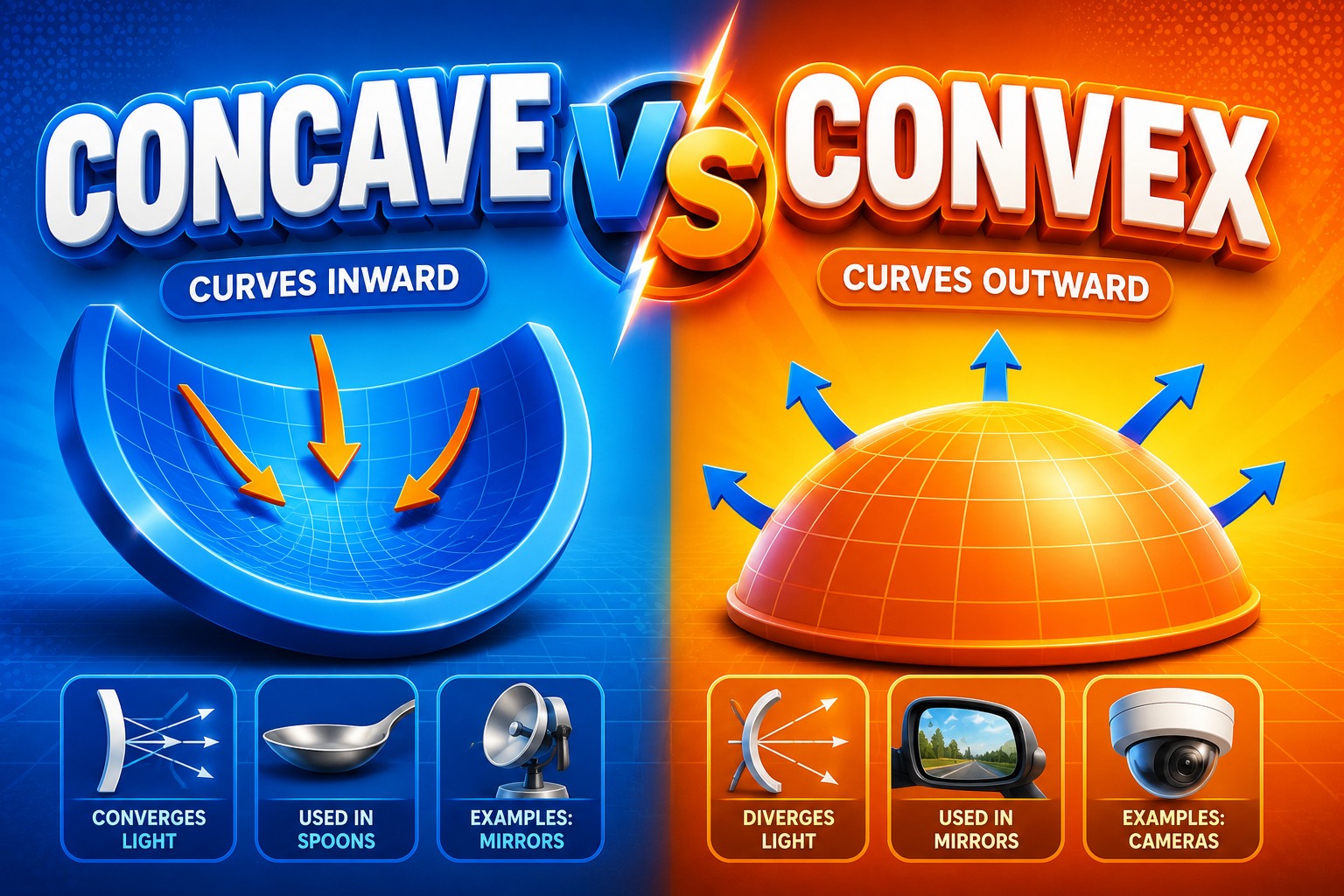
A concave shape curves inward. Think of a cave or a spoon held so you look into the bowl. In geometry, a concave polygon has at least one interior angle greater than 180 degrees, and at least one line segment between two points on the boundary lies outside the shape. In optics, a concave mirror or lens curves inward toward the center.
Definition of Convex
A convex shape curves outward. Imagine the outer surface of a sphere or the back of a spoon. Every line segment connecting two points inside a convex shape stays completely inside the shape. Convex mirrors and lenses bulge outward from the center.
Background and Origin of the Terms
The words come from Latin. “Concave” combines “con-” (with) and “cavus” (hollow), literally meaning “hollowed with.” “Convex” comes from “con-” and “vehere” (to carry), describing a surface that is carried outward or arched. Mathematicians and physicists adopted these terms centuries ago to describe curved surfaces precisely. Today the distinction remains essential in Concave vs Convex discussions across multiple fields.
Why People Confuse Concave vs Convex
The confusion usually starts with mirrors and lenses. People remember that one magnifies and one reduces size, but forget which is which. Visual memory helps: a concave surface looks like it could hold water; a convex surface sheds water. Remembering this simple test clears up most mix-ups about Concave vs Convex.
Importance of Understanding the Difference
Knowing Concave vs Convex improves accuracy in geometry problems, helps select the right optical tools, supports safer vehicle design, and even appears in architecture and product design. Students who master the difference perform better in physics labs. Professionals in engineering and photography rely on it daily.
Key Features of Concave vs Convex
Characteristics of Concave Shapes
- Curve inward
- Can focus parallel rays of light to a point
- Produce real or virtual images depending on object distance
- In polygons, at least one internal angle exceeds 180°
- Appear “caved in” or depressed
Characteristics of Convex Shapes
- Curve outward
- Spread parallel rays of light
- Always produce virtual, upright, diminished images (for mirrors)
- Every internal angle of a convex polygon is less than or equal to 180°
- Appear bulged or rounded outward
Differences Between Concave and Convex
The core difference in Concave vs Convex is the direction of curvature. Concave surfaces bend toward the observer or center; convex surfaces bend away. This single difference changes reflection, refraction, field of view, and mathematical properties.
Visual Identification Tips
Hold an imaginary spoon. The side that holds soup is concave. The back of the spoon is convex. For polygons, draw a line between two points on the edge. If the line stays inside, the shape is convex. If any part of the line goes outside, the shape is concave. These quick checks make Concave vs Convex identification reliable.
Real-World Applications
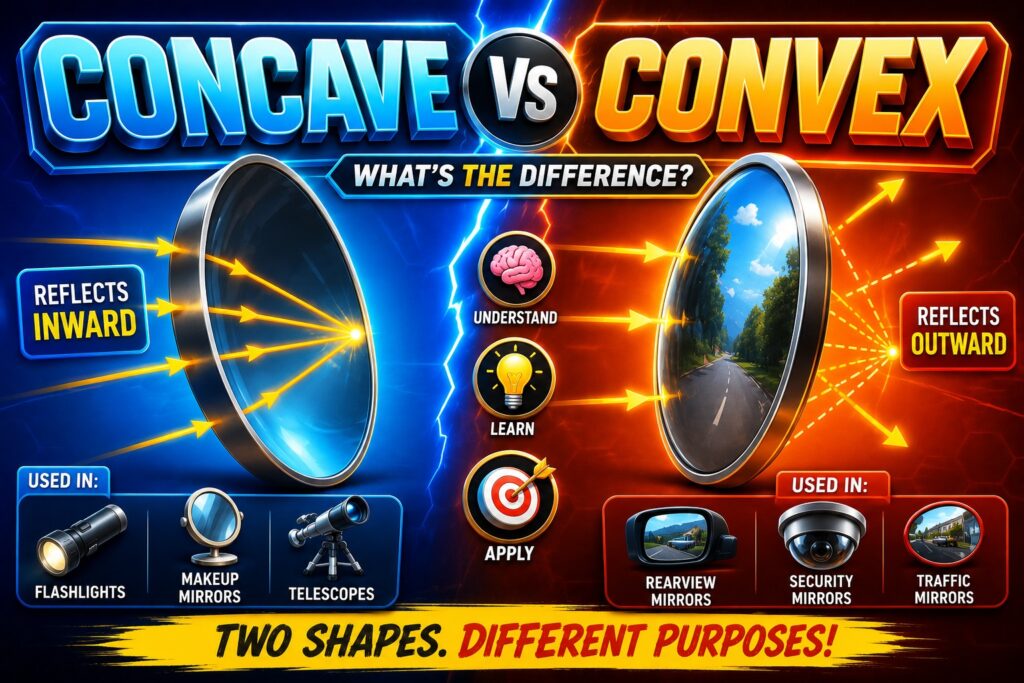
Concave mirrors appear in telescopes, headlights, and makeup mirrors. Convex mirrors sit on vehicle side mirrors and security systems. Concave lenses correct nearsightedness; convex lenses correct farsightedness and form images in cameras. Understanding Concave vs Convex shapes also guides architects when designing curved walls and engineers when analyzing stress on surfaces.
What Makes Concave and Convex Unique
Concave surfaces can concentrate energy (light or sound). Convex surfaces disperse it and expand the visible area. That unique pair of behaviors is why Concave vs Convex remains a foundational concept rather than a minor detail.
How Concave vs Convex Works
Step-by-Step Explanation
- Identify the surface or shape.
- Determine whether the curve bends inward or outward relative to the center or the observer.
- For light: apply the law of reflection or refraction.
- For polygons: test line segments between boundary points.
- Predict the result—focused image, wider view, or geometric property.
How to Identify Concave Objects
Look for an inward dent or hollow. A satellite dish, a cave entrance, or the inner side of a bowl all qualify as concave. In Concave vs Convex tests, if water would collect in the curve, it is concave.
How to Identify Convex Objects
Look for an outward bulge. A basketball, the outer side of a helmet, or a dome roof are convex. Water runs off these surfaces.
Simple Explanation with Examples
A concave mirror held close to your face magnifies your features because light rays converge after reflection. A convex mirror shows a wide, smaller view of the room behind you because rays diverge. The same principle applies to Concave vs Convex lenses used in eyeglasses.
Understanding Inward and Outward Curves
Inward = concave. Outward = convex. This rule works for three-dimensional objects, two-dimensional shapes, and optical surfaces. Mastering the direction removes most confusion about Concave vs Convex.
Easy Technical Overview
In mathematics, a set is convex if the line segment between any two points in the set lies entirely within the set. A concave set fails this test for at least one pair of points. In optics, the focal length sign convention differs: concave mirrors have positive focal length in the common sign system, while convex mirrors have negative focal length. These technical details reinforce everyday observation of Concave vs Convex.
Benefits of Understanding Concave vs Convex
Mastering Concave vs Convex strengthens mathematical reasoning. Geometry students solve polygon classification problems faster. Physics students predict image locations in ray diagrams with confidence. Optics knowledge helps when choosing camera lenses or understanding how the human eye focuses light.
In engineering and architecture, curved surfaces affect strength and aesthetics. Concave and convex forms appear in bridges, stadium roofs, and product casings. Professionals who understand Concave vs Convex make better design decisions.
Students gain an advantage in exams. Professionals in photography, automotive design, and medical imaging use the concepts daily. Everyday users benefit when they understand why a side-view mirror says “objects in mirror are closer than they appear”—a direct result of the convex shape.
Popular Examples of Concave vs Convex
Concave Mirror
A concave mirror curves inward. It focuses light and can produce magnified images of nearby objects. Shaving mirrors and reflecting telescopes use this property.
Convex Mirror
A convex mirror curves outward. It provides a wide field of view and always forms diminished virtual images. Vehicle side mirrors and store security mirrors rely on this behavior. The comparison of concave vs convex mirror performance is one of the clearest illustrations of the difference.
Concave Lens
A concave lens is thinner in the middle than at the edges. It diverges light rays and is used to correct myopia (nearsightedness).
Convex Lens
A convex lens is thicker in the middle. It converges light rays and is used in cameras, projectors, and to correct hyperopia (farsightedness). Studying concave vs convex lens pairs is standard in school optics labs.
Concave Polygon
A concave polygon has at least one reflex interior angle. A star-shaped polygon or an arrowhead shape is typically concave.
Convex Polygon
A convex polygon has all interior angles less than or equal to 180°. Regular polygons such as squares, equilateral triangles, and regular hexagons are convex. The distinction between concave and convex shapes in geometry begins with this polygon test.
Everyday Household Examples
Spoons (concave inside, convex outside), bowls, contact lenses, reading glasses, and decorative curved mirrors all demonstrate Concave vs Convex principles.
Applications in Vehicles, Telescopes, and Cameras
Cars use convex side mirrors for safety. Reflecting telescopes use large concave mirrors to gather light. Smartphone cameras combine multiple convex and concave lens elements to focus images sharply across different distances. These real-world uses show why Concave vs Convex knowledge matters beyond the classroom.
How to Get Started with Concave vs Convex
Begin with the basic definitions. Memorize that concave curves in and convex curves out. Next, study clear visual examples—photographs of mirrors, lenses, and polygons labeled correctly. Practice by walking around your home and classifying curved objects.
Understand mirrors and lenses by performing simple experiments with a spoon or a pair of glasses. Hold the spoon and observe your reflection on both sides. Note the difference in image size and orientation. These hands-on steps make Concave vs Convex concrete.
Tips for beginners:
- Use the “cave” memory trick for concave.
- Draw line segments on paper shapes to test convexity.
- Sketch simple ray diagrams for mirrors and lenses.
- Review concave vs convex examples regularly until recognition becomes automatic.
Pros and Cons of Concave vs Convex
Pros of Concave
- Can focus light to a point
- Used in telescopes and shaving mirrors
- Magnifies nearby objects
- Useful for collecting energy or sound
Cons of Concave
- Limited field of view
- Image characteristics vary strongly with object distance
- Can produce inverted images that confuse beginners
Pros of Convex
- Wider field of view
- Safer for vehicle mirrors
- Useful for surveillance and security
- Always produces upright images (mirrors)
Cons of Convex
- Objects appear smaller
- Reduced detail at a distance
- Cannot focus parallel rays to a real point
These advantages and disadvantages explain why designers choose one shape over the other depending on the goal. The practical trade-offs in Concave vs Convex applications guide engineering decisions every day.
Common Issues and Troubleshooting
Confusing Concave and Convex
Solution: Repeat the cave-and-ball memory aid. Practice with physical objects until the association sticks.
Identifying Mirrors and Lenses
Solution: Feel the surface if possible. Concave feels hollow; convex feels raised. For lenses, note which part is thicker.
Geometry Mistakes
Solution: Always test with a straightedge. Draw diagonals or boundary segments. If any segment exits the shape, it is concave.
Misunderstanding Image Formation
Solution: Sketch ray diagrams step by step. Label object distance relative to focal length. Practice with both concave vs convex mirror and concave vs convex lens cases.
Difficulty Remembering the Differences
Solution: Create a simple two-column chart listing properties side by side. Review the chart weekly until the contrast becomes automatic. Consistent exposure to Concave vs Convex examples builds lasting recognition.
Future of Concave vs Convex Applications
Advanced optical technology continues to refine Concave vs Convex surfaces with nanometer precision. Medical imaging systems use carefully shaped lenses and mirrors for clearer internal views. Automotive safety systems rely on wide-angle convex mirrors and cameras that incorporate complex lens combinations.
Smartphone cameras pack multiple concave and convex shapes into tiny modules to deliver zoom, portrait, and ultra-wide modes. Space telescopes, including future designs, employ large concave primary mirrors to collect faint light from distant galaxies. Engineers explore adaptive optics that can change curvature slightly, blending the best traits of both shapes.
Future innovations will likely combine traditional Concave vs Convex principles with computational imaging, allowing software to correct optical limits in real time. Understanding the fundamental difference remains the starting point for these advances.
Conclusion
The 5 key differences between concave and convex shapes center on direction of curvature, light behavior, field of view, image characteristics, and geometric properties. Concave surfaces curve inward, focus light, and can magnify nearby objects. Convex surfaces curve outward, spread light, and expand the visible area while making objects appear smaller. These contrasts appear in Concave vs Convex mirrors, lenses, polygons, and countless everyday objects.
From mathematics classrooms to vehicle design, telescopes, cameras, and medical tools, the distinction between Concave vs Convex shapes proves practical and powerful. Master the simple inward-versus-outward rule, practice with real examples, and you will recognize the difference instantly.
Explore more Concave vs Convex examples around you today—look at mirrors, lenses, bowls, and curved architecture. Practice identifying them. The clearer your understanding becomes, the more confidently you will apply geometry, optics, and design principles in school, work, and daily life.