It was a rainy Tuesday afternoon, and I was staring at a half-finished client brief that needed to sound brilliant by morning. My usual go-to, ChatGPT, had given me solid but somewhat predictable prose. On a whim, I pasted the same prompt into Gemini. The difference wasn’t night and day—it was more like switching from a reliable sedan to a sports car that knew the shortcuts. That moment stuck with me. In the fast-evolving world of AI, Google Gemini vs ChatGPT isn’t just tech-bro fodder anymore; it’s a daily decision that shapes how we work, create, and think.
I’ve spent the better part of the last year pitting these two against each other across real projects—writing articles, debugging code, planning marketing campaigns, and even generating visuals for pitches. This isn’t a sterile benchmark roundup. It’s the honest take from someone who relies on them to pay the bills. By the end, you’ll know which one deserves prime real estate on your toolbar and why the choice often comes down to how you work rather than which is “better.”
The Evolution That Got Us Here
Remember when ChatGPT dropped and felt like magic? It redefined what conversational AI could be. Google, never one to sit idle, rebranded Bard into Gemini and has been iterating furiously. As of mid-2026, we’re looking at Gemini 3.1 Pro (and its speedy Flash variant) going toe-to-toe with OpenAI’s GPT-5.2 series.
What’s changed? Context windows have ballooned, multimodal capabilities are table stakes, and both companies are embedding their models deeper into everyday tools. Yet the philosophies remain distinct. OpenAI built ChatGPT as a versatile creative partner. Google engineered Gemini as a deeply integrated, search-augmented powerhouse.
Speed, Accuracy, and Real-Time Knowledge: Where Gemini Often Pulls Ahead
One area where Google Gemini vs ChatGPT shows a clear divide is freshness of information. Gemini’s native integration with Google Search means it pulls real-time data without the clunky “browsing” mode ChatGPT sometimes relies on. Ask about breaking news, stock movements, or the latest algorithm update, and Gemini frequently feels more current.
I tested this during a product launch last quarter. While ChatGPT gave me a thoughtful analysis based on its training cutoff, Gemini surfaced recent competitor moves and sentiment from X and Reddit almost instantly. For researchers, journalists, or anyone in fast-moving industries, this is huge.
Gemini’s Flash model also tends to respond faster on lighter tasks. It’s snappier for quick summaries, data extraction, or turning meeting notes into action items. That said, raw intelligence isn’t always about speed. ChatGPT’s reasoning models (the “thinking” variants) can outperform on complex, multi-step problems where you need the AI to show its work and avoid hallucinations.
Creativity, Writing, and That Human Spark
Here’s where my personal bias shows: I still reach for ChatGPT more often when I need prose that feels alive. Its writing has a natural rhythm and emotional intelligence that Gemini sometimes smooths over into corporate politeness.
Try prompting both for a blog intro or marketing email. ChatGPT often delivers more varied sentence structure and subtle wit. Gemini excels at structured output—perfect outlines, bullet-proof frameworks, and content that’s immediately usable in Google Docs or Slides. But it can feel a bit more restrained, almost as if it’s double-checking against some internal safety layer.
I once asked both to rewrite a personal essay about burnout in tech. ChatGPT captured the vulnerability with nuance. Gemini produced something cleaner and more motivational—but it lost some of the raw edge that made the original piece resonate. Your mileage will vary depending on whether you prioritize polish or personality.
Coding and Technical Tasks: A Surprisingly Close Race
Developers love to debate this one. ChatGPT has long been the darling of the coding community thanks to excellent context handling in projects and strong debugging instincts. Gemini, especially the Pro variants, has closed the gap significantly with better support for larger codebases and seamless integration with Google’s developer tools.
In my tests, Gemini shines when working within the Android/Flutter ecosystem or when you need to analyze video content alongside code (upload a screencast of a bug, and it can break it down impressively). ChatGPT feels more reliable for general-purpose programming, refactoring legacy code, or explaining concepts in beginner-friendly ways.
Pro tip: Use both in tandem. Start with ChatGPT for architecture and creative solutions, then feed the output to Gemini for optimization and real-time research on libraries.
Multimodal Magic – Images, Video, and Beyond
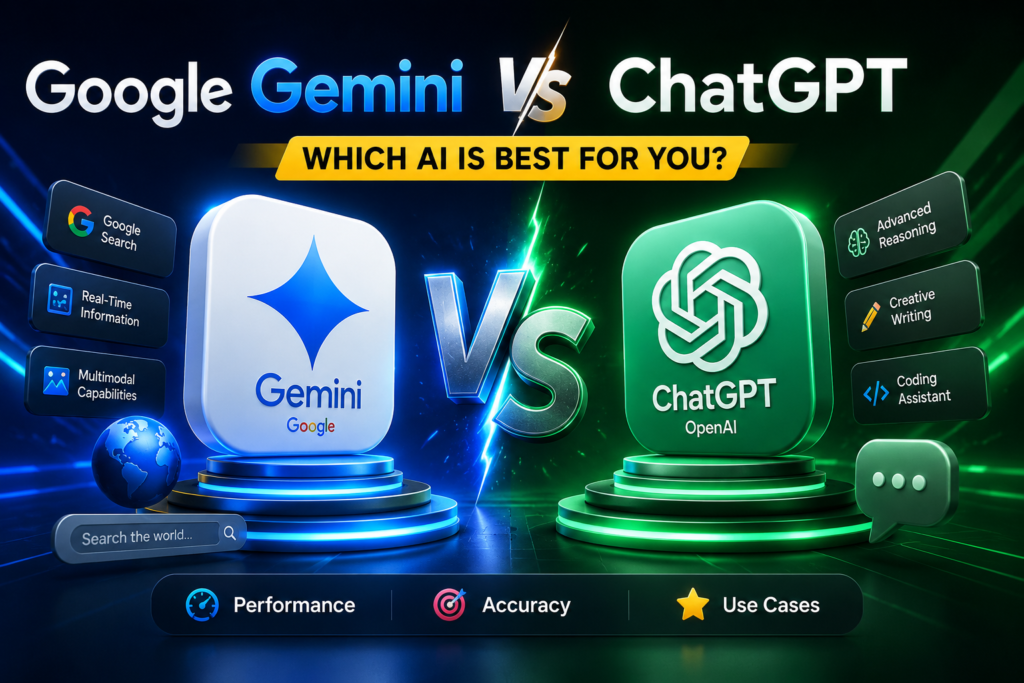
This is where Gemini frequently steals the show. Its native image generation and understanding (powered by Imagen and video models) feel more integrated. Upload a photo and ask for edits, analysis, or even video summaries—Gemini handles it with less friction. ChatGPT’s DALL·E integration is excellent for pure creation, but Gemini’s ecosystem advantage shows when you’re already living in Gmail, Docs, or YouTube.
I created a pitch deck recently. Gemini helped me pull screenshots from a competitor’s video, generate consistent branding visuals, and even suggest slide layouts that matched my Google Slides template. The workflow felt effortless.
Pricing and Accessibility: Who Gets the Better Deal?
Both offer free tiers that are surprisingly capable for casual use. The paid plans hover around $20/month for premium access.
- ChatGPT Plus/Pro: Excellent for heavy writers and researchers. The voice mode and advanced reasoning features justify the cost for many.
- Gemini Advanced: Deeper Google Workspace integration. If you’re already paying for Google One or use Sheets/Docs heavily, the value compounds quickly.
Watch for enterprise deals—Google often bundles Gemini more aggressively with business suites.
Real-World Scenarios: Which One Should You Use When?
Choose Gemini if you:
- Live in Google’s ecosystem (Workspace, Android, YouTube creators)
- Need fast research and current events
- Work with images, video, or large documents
- Prioritize structured productivity and speed
Choose ChatGPT if you:
- Do deep creative writing or storytelling
- Tackle complex reasoning or planning problems
- Want the most polished conversational experience
- Value customization and a vibrant plugin/custom GPT community
Many power users (myself included) keep both open. The real skill is knowing which tool to tap for the job.
Common Pitfalls and Expert Tips I’ve Learned the Hard Way
Don’t treat either as infallible. Both can hallucinate, especially on niche topics. Always verify critical information. I’ve seen Gemini confidently cite outdated policies and ChatGPT invent elegant but non-existent code functions.
Actionable advice:
- Use specific, role-based prompts (“Act as a senior marketing strategist with 15 years experience…”).
- Chain models: Generate with one, refine with the other.
- For long projects, maintain a running conversation with context rather than new chats.
- Experiment with temperature settings or “thinking” modes for different needs—creative vs analytical.
Avoid the trap of over-relying on AI for final output. The best results come when you treat them as brilliant (but flawed) collaborators, not replacements for your judgment.
The Bigger Picture: What This Means for All of Us
Google Gemini vs ChatGPT represents more than two chatbots. It’s a clash of tech giants’ visions for the future—one more open and exploratory, the other deeply woven into the tools billions already use daily. Gemini’s growth in user numbers has been impressive, signaling that integration might win the mass market even if ChatGPT retains the creative edge.
What excites me most isn’t who’s ahead this month. It’s how quickly these tools are becoming invisible infrastructure. The winners won’t be the people who pick the “best” AI—they’ll be the ones who master using multiple AIs in concert with their own unique skills.
The next time you’re stuck on a project, try both. Notice the differences. That small habit of comparison will sharpen your own thinking more than any single model ever could.
In the end, Google Gemini vs ChatGPT isn’t a battle with one clear victor. It’s a toolbox, and the smartest move is knowing exactly which hammer (or scalpel) to grab for the nail in front of you. Now go build something remarkable.