
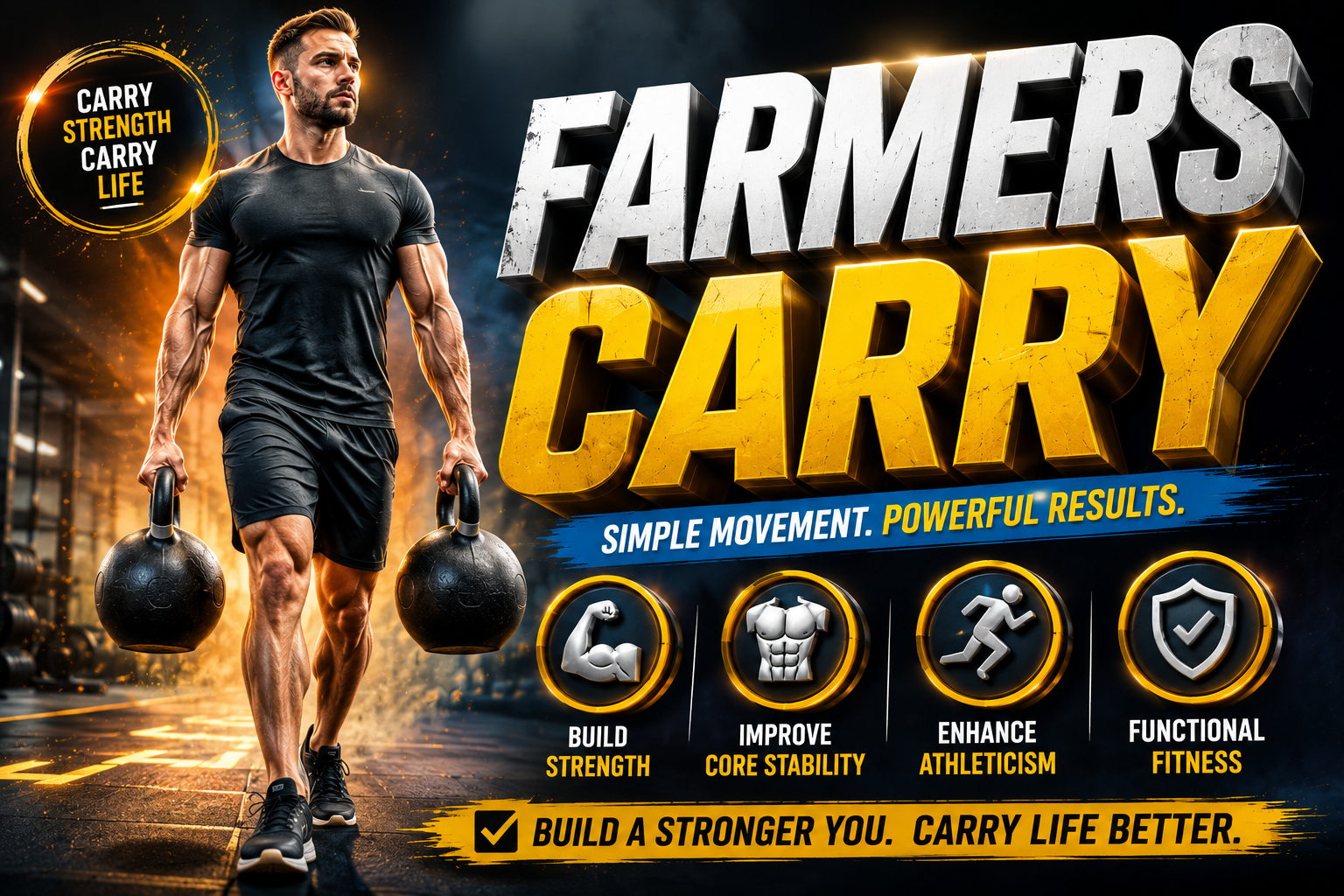
I still remember the first time I tried a proper farmers carry. I loaded up a pair of heavy dumbbells in my garage gym, took what I thought was a confident first step, and within twenty yards my forearms were screaming, my shoulders felt like they were on fire, and my core was shaking like a leaf. By the end of the walk, I was breathing harder than after most barbell workouts. That moment taught me something important: the farmers carry doesn’t just test your muscles—it exposes every weakness in your kinetic chain with brutal honesty.
If you’ve ever felt strong in the gym but struggled with real-life tasks like hauling equipment, carrying heavy shopping, or even just keeping your posture solid during a long day, this exercise might be the missing piece. In this article, we’re diving deep into the farmers carry—what it is, why it delivers unmatched functional strength, how to perform it correctly, and how to weave it into your training so it actually translates to better performance and resilience.
What Exactly Is the Farmers Carry?
At its core, the farmers carry is as straightforward as strength training gets. You pick up a pair of heavy weights—dumbbells, kettlebells, trap bars, or even actual farmer’s handles—and walk with them for distance or time. No fancy technique required on the surface, yet the demands it places on your body are profound.
The beauty lies in its simplicity. While most gym exercises are static or happen in one plane of motion, the farmers carry forces your entire body to stabilize, move, and adapt under load while progressing forward. Your grip has to stay locked, your shoulders must stay packed, your core works overtime to prevent swaying, and your legs drive the whole system forward. It’s one of the few moves that trains the body the way life actually works—under load, in motion, and often when you’re already a little tired.
I’ve seen seasoned lifters who can deadlift impressive numbers get completely humbled by a solid farmers carry session. That’s because it doesn’t let you hide behind momentum or leverage tricks. It’s raw, honest work.
Why the Farmers Carry Deserves a Permanent Spot in Your Program
The farmers carry isn’t just another accessory movement. It builds a unique combination of attributes that compound into real-world capability.
Grip and Forearm Strength: Nothing builds crushing grip like holding heavy weights while walking. Stronger hands and forearms carry over to deadlifts, pull-ups, and even everyday tasks like opening jars or gripping tools without fatigue.
Core Stability and Anti-Rotation Power: As you walk, your core fights to keep your torso from twisting or leaning. This develops deep, functional abdominal strength that braces your spine under dynamic conditions—far more useful than endless crunches.
Postural Strength and Shoulder Health: Carrying heavy loads teaches your upper back and traps to stay engaged. Over time, this improves posture and reduces the risk of shoulder injuries by strengthening the stabilizing muscles that often get neglected in pushing-focused programs.
Mental Toughness: There’s something deeply satisfying—and slightly miserable—about pushing through the burn when your grip is failing but you still have distance left to cover. That mental edge transfers beautifully to other lifts and challenges.
Studies and coaching experience consistently show that loaded carries improve overall athleticism. They enhance work capacity, boost testosterone response in some trainees, and even help with fat loss because they’re metabolically demanding when done right.
How to Perform the Farmers Carry with Perfect Form
Getting the technique right separates good results from great ones—and keeps you injury-free.
Start by selecting weights that challenge you but allow good posture for the full distance. Stand between your implements, hinge at the hips slightly, grip the handles firmly, and stand up tall with your shoulders pulled back and down. Brace your core as if you’re about to get punched in the stomach. Look straight ahead, take controlled steps, and focus on short, powerful strides rather than shuffling.
Key cues I give clients:
- Keep your ribs down and avoid arching your lower back.
- Don’t let the weights swing or bang against your legs.
- Breathe steadily—don’t hold your breath the entire set.
- If using one weight (single-arm carry), stay tall and resist leaning toward the heavy side.
Aim for 20–50 meters per carry initially, depending on your fitness level. Rest 60–90 seconds between sets. Three to five rounds is plenty for most people.
Variations That Keep the Farmers Carry Fresh and Effective
The standard two-arm dumbbell version is excellent, but variety prevents boredom and attacks weaknesses from different angles.
Trap Bar Farmers Carry: Using a trap bar allows heavier loads and feels more natural for many people because the weight sits closer to your center of gravity.
Single-Arm Farmers Carry (Suitcase Carry): This variation torches your obliques and improves lateral stability. Great for correcting imbalances.
Overhead Farmers Carry: Hold weights locked out overhead. This adds serious shoulder stability demands and core work.
Mixed Grip or Offset Carries: One heavy weight and one lighter, or different implements entirely. These challenge coordination and anti-rotation even more.
Yoke or Frame Carries: If you have access to strongman equipment, these take the farmers carry to another level of intensity.
I often program different variations throughout a training block. Heavy trap bar carries early in the week for strength, lighter single-arm versions later for recovery and stability work.
Common Mistakes That Sabotage Your Progress
Even experienced trainees mess this up. The biggest error is choosing weights that are too heavy, which destroys posture and turns the movement into a sloppy waddle. Ego loading here leads to poor gains and potential back strain.
Another frequent issue is rushing the walk. Speed should be controlled—quick enough to create demand but deliberate enough to maintain tension. Short, choppy steps are better than long strides that cause excessive sway.
Gripping too tightly from the start can lead to premature forearm fatigue. Learn to hold firmly but not with death-grip intensity until necessary. And always set the weights down under control rather than dropping them, especially with dumbbells.
Watch for forward head posture or rounded shoulders. Film yourself occasionally. The mirror lies; video doesn’t.
Programming the Farmers Carry for Different Goals
How you integrate farmers carries depends on what you’re trying to achieve.
For strength and muscle building, use heavier loads for shorter distances (20–30 meters) with longer rest periods. Do them after your main lifts when you’re still relatively fresh.
For conditioning and fat loss, lighter to moderate weights for longer distances or timed walks work wonders. These make fantastic finishers.
For athletic performance, mix them into circuits with other movement patterns—think carry followed by push-ups or lunges.
Beginners might start with bodyweight marches or very light loads to groove the pattern. Intermediate lifters can handle significant percentages of their bodyweight (some strong athletes carry over 100% of bodyweight total). Advanced trainees experiment with timed challenges or complex variations.
One of my favorite protocols is the “Farmer’s Walk Complex”: three different carry variations back-to-back with minimal rest. It’s short but leaves you feeling like you’ve done real work.
Real-World Stories and Unexpected Benefits
I once trained a construction worker who could deadlift respectably but constantly complained about lower back fatigue on job sites. After adding consistent farmers carries twice a week, his ability to carry materials improved dramatically, and his back pain decreased. The loaded walking strengthened his entire posterior chain and taught better bracing under fatigue.
Another client, a busy mom, found that farmers carries improved her confidence carrying toddlers and groceries simultaneously. The exercise bridged the gap between gym strength and daily demands in a way that isolation work never could.
Even for desk workers, the postural benefits are noticeable within weeks. Better shoulder position, less neck tension, and an easier time sitting or standing tall.
Advanced Tips from Years of Coaching
- Pair farmers carries with deadlift variations on the same day. The carry acts as a natural finisher that reinforces the hinge pattern.
- Use chalk or liquid chalk for heavy sessions. Grip failure should come from muscular fatigue, not slippery hands.
- Track your total distance and load over time. Progressive overload matters here just like with any lift.
- Don’t neglect recovery. Heavy carries are taxing on the nervous system and grip. Balance them with adequate rest days.
- Experiment with barefoot or minimalist shoe carries occasionally (on safe surfaces) to improve foot strength and proprioception.
Making the Farmers Carry Part of Your Long-Term Training
The real magic happens when this movement becomes a staple rather than an occasional add-on. It doesn’t require fancy equipment or complicated programming. Just heavy things and space to walk.
Over months and years, consistent farmers carries build a rugged, capable body that performs when it counts. You’ll notice better endurance in other lifts, improved mental fortitude during tough sets, and that quiet confidence that comes from knowing you can handle physical demands outside the gym.
Start simple this week. Grab whatever heavy implements you have available, walk with purpose, and feel what your body tells you. The farmers carry has a way of revealing exactly where you stand—and then quietly making you stronger in ways that matter most.
The next time life throws something heavy your way—whether it’s moving furniture, helping a friend, or just navigating a demanding day—you’ll be better prepared because of it. That, more than any Instagram-worthy lift, is what training should deliver.