

Are you unsure whether to use flier or flyer in your next marketing campaign, business document, or school project? The flier vs flyer debate confuses many writers, designers, and marketers. Both spellings refer to similar concepts, yet subtle differences in usage, context, and regional preferences matter.
In this comprehensive guide on flier vs flyer, we’ll explore definitions, history, real-world applications, and practical tips. By the end, you’ll confidently choose the right spelling every time, improving your content’s professionalism and SEO performance.
What is Flier vs Flyer?
Definition of Flier
Flier typically refers to a person or thing that flies. You might see it used for pilots, passengers on airplanes, or someone taking a risk (as in “take a flier”). In some style guides, it’s also applied to handbills or promotional sheets, though this is less common today.
Definition of Flyer
Flyer is the more prevalent spelling for promotional materials—those colorful sheets handed out at events, posted on bulletin boards, or distributed in mailers. It also appears frequently for people who fly, especially in airline loyalty programs like “frequent flyer miles.”
Historical Background
Both spellings evolved from the verb “to fly.” “Flyer” has roots in older English usage for things that fly or promote movement. “Flier” emerged as a variant, gaining traction in American English for aviators. Over time, the distinction blurred due to printing, advertising, and globalization.
Why Both Spellings Exist
Language evolves through regional influences, industry standards, and common usage. Dictionaries often accept both as variants, but context and style guides dictate preferences. This flexibility leads to the ongoing flier vs flyer discussion in writing communities.
Purpose and Relevance
In marketing and advertising, the right choice affects brand perception. In education, it teaches precision. In business, consistency builds credibility. Everyday English benefits from clarity, reducing reader confusion in a world full of digital and print content.
Flier vs flyer appears in countless searches because professionals want authoritative guidance. Understanding both ensures your materials stand out.
Key Features of Flier vs Flyer
Main Differences
- Flier: Often emphasizes the action of flying or risk-taking (“take a flier”).
- Flyer: Dominates promotional contexts and is increasingly standard for aviation references.
Similarities
Both spellings are grammatically correct in many dictionaries and can sometimes be used interchangeably. They share the same pronunciation and core meanings related to flight or distribution.
Regional Usage (US vs UK)
- In American English, “flyer” has gained ground, especially post-2017 AP Style updates.
- In British English, “flyer” is often preferred for leaflets, while both appear in aviation contexts.
Global audiences see “flyer” more frequently in digital marketing.
AP Style and Common Publishing Preferences
The AP Stylebook, a major journalism standard, prefers flyer for handbills and people who fly. It reserves flier mainly for “take a flier” (meaning to take a risk). This 2017 change aligned with airline marketing like “frequent flyer” programs.
Chicago Manual of Style and others are more flexible, but consistency is key.
Situations Where Each Spelling is Appropriate
Use flyer for event promotions, business ads, and most general writing. Opt for flier in specific idiomatic expressions or when a style guide mandates it. Always consider your audience in the flier vs flyer decision.
How Flier vs Flyer Works in Real-Life Usage
Choosing the correct spelling follows a simple process:
- Identify the context — Is it promotional or aviation-related?
- Check your style guide — AP? Chicago? Brand-specific?
- Consider audience — US, UK, or international?
- Maintain consistency — Pick one and stick with it in the document.
- Proofread — Tools like Grammarly can flag inconsistencies.
Examples in Marketing, Aviation, Education, and Business
- Marketing: “We printed 5,000 flyers for the grand opening.” (Promotional sheet)
- Aviation: “Frequent flyer members earn bonus miles.” (Airline preference)
- Education: “The teacher distributed flyers about the field trip.”
- Business: “Investors sometimes take a flier on startup ideas.”
Simple Grammar Overview
Both are nouns (and occasionally verbs). They follow standard pluralization: flyers/fliers. In sentences, they function as subjects or objects without special rules beyond context.
Flier vs flyer questions often arise in content creation, where precision enhances readability.
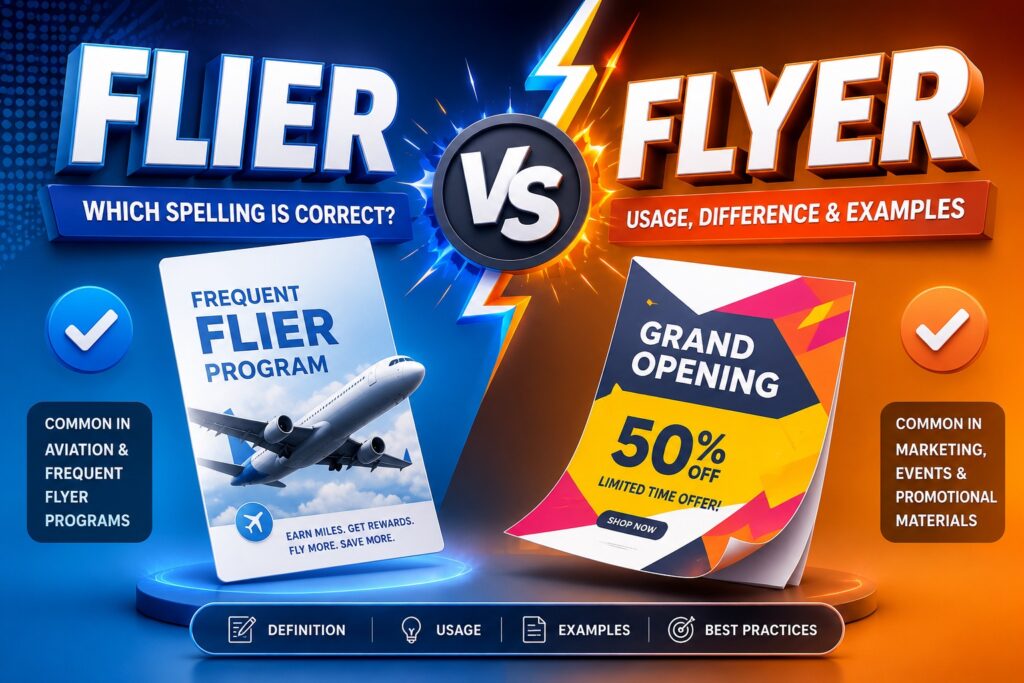
Benefits of Understanding Flier vs Flyer
Mastering flier vs flyer offers multiple advantages:
- Avoids spelling mistakes: Professional documents look polished.
- Improves professional writing: Editors and clients notice attention to detail.
- Helps businesses create better marketing materials: Consistent “flyer” usage aligns with industry norms.
- Useful for students, designers, marketers, and writers: It builds confidence across disciplines.
For SEO, targeting flier vs flyer difference, flyer spelling, and flier meaning can drive targeted traffic.
Popular Examples of Flier vs Flyer
Business Flyer
A business flyer promotes services, products, or sales. Example: “Download our company flyer for special offers.”
Event Flyer
Event flyers announce concerts, workshops, or fundraisers. Designers use eye-catching graphics on these promotional pieces.
Promotional Flyer
Promotional flyers drive awareness. “The marketing team designed a vibrant promotional flyer.”
Political Campaign Flyer
Candidates distribute political campaign flyers door-to-door. They highlight platforms and calls to action.
Airline Frequent Flier Program
Airlines use frequent flyer (note the spelling) for loyalty programs: “Join our frequent flyer program today.”
Advertising Flyer
Advertising flyers are cost-effective for local businesses. They often include coupons or QR codes.
These examples illustrate how flyer dominates marketing while flier fits specific phrases.
How to Get Started
Learn the Context Before Choosing the Spelling
Always analyze whether the word describes a handout or a person/thing that flies.
Follow Your Style Guide (AP, Chicago, etc.)
AP Style favors flyer in most cases. Check your organization’s guidelines.
Use Flyer for Most Marketing Materials
For flyer for marketing, this spelling is safest and most recognizable.
Use Flier Where Officially Required (e.g., Frequent Flier Programs)
Some legacy contexts or specific idioms prefer flier. Respect brand voice in flier vs flyer choices.
Pros and Cons
Pros
- Better communication: Clear writing reduces misunderstandings.
- Professional content: Impresses clients and audiences.
- Improved SEO when targeting the right keyword: Articles on flier vs flyer rank well for informational searches.
- Better reader understanding: Readers appreciate precision.
Cons
- Can confuse beginners: The similarity trips up new writers.
- Different style guides recommend different spellings: Creates inconsistency across publications.
- Search intent may vary: Some users search flyer or flier, leading to mixed results.
Common Issues and Troubleshooting
Common Mistakes
- Using flier instead of flyer in marketing → Solution: Default to flyer for promotions.
- Mixing both spellings in one article → Solution: Run a find-and-replace after drafting.
- Ignoring audience preference → Solution: Research target demographics (US vs. UK).
- Following the wrong style guide → Solution: Confirm guidelines at the project start.
Simple tools like spell-checkers and style checkers help troubleshoot flier vs flyer issues.
Future of Flier vs Flyer
Search Trends
Flier vs flyer queries remain steady as content creators seek clarity. “Flyer spelling” and “flyer vs flier AP style” are popular long-tail keywords.
Digital Marketing Usage
Flyer continues dominating online and print advertising due to its visual appeal in design software.
AI Writing Tools and Spelling Preferences
AI tools often default to flyer based on frequency data, helping users navigate flier meaning and flyer meaning.
Expected Future Usage in Online Content
“Flyer” will likely prevail in most contexts, but both spellings will persist due to established programs and idiomatic expressions. Writers should stay adaptable.
Conclusion
The flier vs flyer dilemma boils down to context, audience, and style preferences. Flyer is the go-to for marketing materials, events, and most modern writing, including frequent flyer programs. Flier shines in specific risk-related idioms and some traditional aviation references.
Recommendation: Use flyer unless your style guide or brand specifies otherwise. Always prioritize consistency.
By understanding flier vs flyer difference, you enhance your writing, marketing, and communication skills. Next time you create content, you’ll make the right choice confidently. Whether designing a business flyer or discussing aviation, the correct term strengthens