
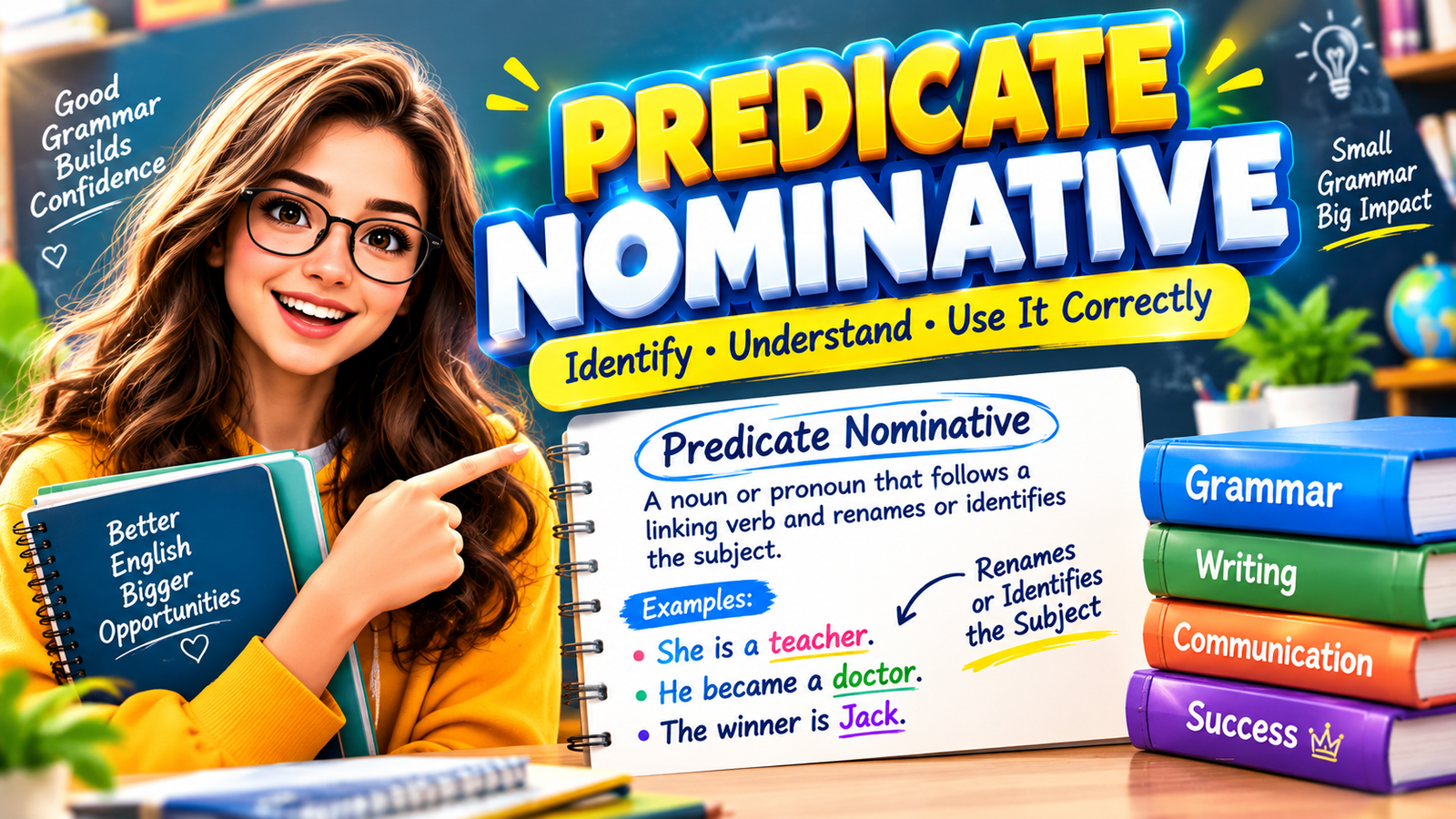
Most people first meet the term “predicate nominative” in a grammar class and immediately wonder why it needs such a formal name. The concept itself is straightforward: it is the noun or pronoun that follows a linking verb and renames the subject. Once you see the pattern, you start noticing it everywhere—in everyday speech, writing, and even song lyrics.
This article explains exactly what a predicate nominative is, how to identify one, how it differs from a predicate adjective, common mistakes that trip people up, and practical ways to use the structure with confidence.
What Is a Predicate Nominative?
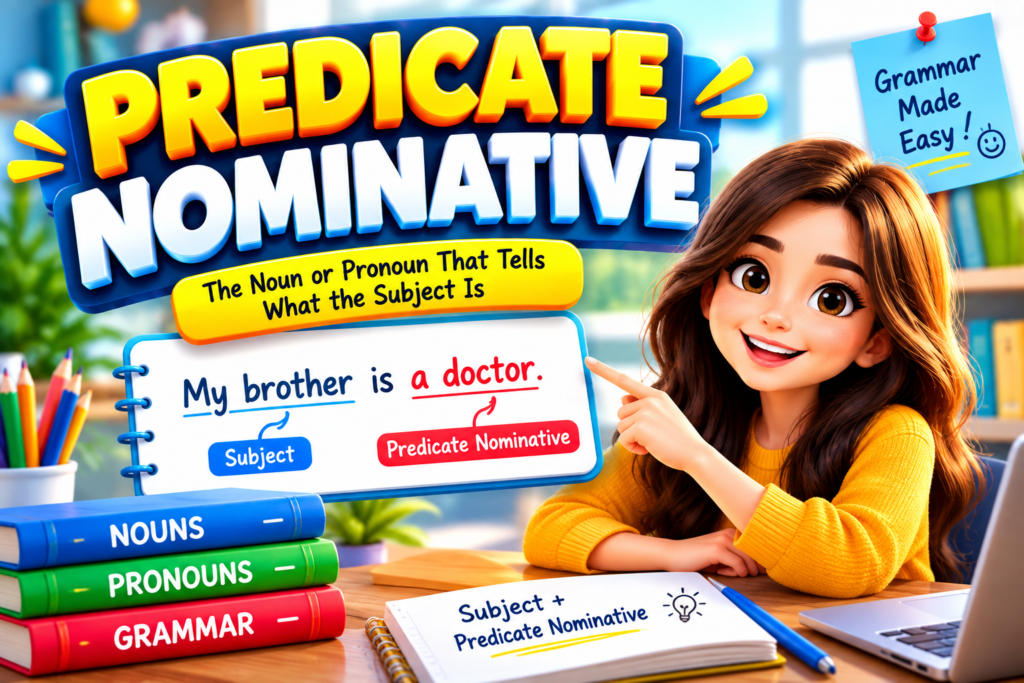
A predicate nominative (also called a predicate noun) is a noun, pronoun, or noun phrase that appears after a linking verb and renames or identifies the subject of the sentence.
Think of it as an equals sign. The subject and the predicate nominative refer to the same person or thing.
- Subject = Predicate nominative
Examples:
- Maria is a teacher.
(Maria = teacher) - The winner was he.
(The winner = he) - My favorite dessert remains chocolate cake.
(My favorite dessert = chocolate cake)
The linking verb does not show action. It simply connects the subject to the word that renames it. The most common linking verb is any form of “to be” (am, is, are, was, were, be, being, been). Other linking verbs include become, remain, seem, appear, and certain uses of feel, look, smell, sound, and taste when they describe a state rather than an action.
How to Identify a Predicate Nominative in a Sentence
Follow these four quick checks:
- Locate the verb. Is it a linking verb?
- Find the subject. Who or what is the sentence about?
- Look at the word or phrase right after the linking verb.
- Ask: Does this word rename or identify the subject? Is it a noun or pronoun?
If the answer to both parts of step 4 is yes, you have a predicate nominative.
Try the “equals” test. Replace the linking verb with an equals sign. If the sentence still makes sense, it is almost certainly a predicate nominative.
- The capital of Texas is Austin. → The capital of Texas = Austin. (Works)
Predicate Nominative vs. Predicate Adjective
This is the most common point of confusion. Both structures follow linking verbs and give information about the subject. The difference is simple:
| Feature | Predicate Nominative | Predicate Adjective |
|---|---|---|
| Part of speech | Noun or pronoun | Adjective |
| Function | Renames or identifies the subject | Describes the subject |
| Example | She is a doctor. | She is happy. |
| Equals-sign test | She = a doctor (makes sense) | She = happy (does not rename) |
More side-by-side examples:
- The sea is a danger. (predicate nominative)
- The sea is dangerous. (predicate adjective)
- He became a leader. (predicate nominative)
- He became confident. (predicate adjective)
If the word after the linking verb is a noun or noun phrase that could stand in for the subject, it is a predicate nominative. If it is an adjective describing a quality, it is a predicate adjective.
Simple, Compound, and Extended Predicate Nominatives
Simple: One noun or pronoun.
“The book is a classic.”
Compound: Two or more nouns joined by a coordinating conjunction.
“Her parents are doctors and teachers.”
“The finalists were Mia, Jordan, and Sam.”
Extended: A longer noun phrase that includes modifiers.
“Sejong the Great was the beloved ruler of Korea from 1418 until 1450.”
Gerunds (verbs ending in -ing that function as nouns) can also serve as predicate nominatives:
“His favorite activity is running.”
Noun clauses sometimes appear as well:
“The problem is that no one checked the data.”
Pronoun Case with Predicate Nominatives
Because a predicate nominative renames the subject, formal grammar requires the subjective (nominative) case of pronouns:
- It is I.
- The winner is she.
- This is he.
In everyday conversation, most native speakers say “It’s me” or “That’s him.” Both forms appear in reputable writing, but the subjective case remains the preferred choice in formal contexts such as academic papers, professional correspondence, or careful public speaking. Knowing the formal rule lets you choose the tone that fits the situation.
Common Mistakes and How to Avoid Them
- Treating an action verb as a linking verb
Wrong: She painted a teacher.
Right: She became a teacher.
Action verbs take direct objects, not predicate nominatives. - Confusing predicate nominatives with direct objects
“He met the teacher.” → “the teacher” receives the action (direct object).
“He is the teacher.” → “the teacher” renames the subject (predicate nominative). - Using the objective case of a pronoun in formal writing
Informal (common): It’s me.
Formal: It is I. - Mixing up number agreement
The verb agrees with the subject, not the predicate nominative.
“The problem is the high costs.” (subject “problem” is singular) - Assuming every noun after a linking verb is a predicate nominative
Sometimes the noun is part of a longer structure or an object complement after verbs like call, name, or elect:
“They named him captain.” (object + object complement)
Why the Structure Matters in Real Writing
Predicate nominatives let writers define, identify, and clarify with precision. They appear constantly in definitions, introductions, and statements of identity:
- “My brother is an engineer.”
- “The solution remains a balanced approach.”
- “You are the change we need.”
In literature and speeches they create memorable equations:
“I could have been a contender.” (On the Waterfront)
Understanding the pattern also helps with editing. When a sentence feels incomplete after a linking verb, a missing or weak predicate nominative is often the culprit.
Practical Tips for Using Predicate Nominatives Well
- Prefer specific nouns over vague ones when the goal is clarity.
“She is a mentor” is stronger than “She is someone helpful.” - Use compound forms to pack more information efficiently.
“The candidates are experienced managers and proven innovators.” - In formal writing, choose the subjective pronoun when the structure calls for it.
In dialogue or casual prose, the objective form usually sounds more natural. - When in doubt, apply the equals-sign test and check whether the word after the linking verb is a noun that renames the subject.
FAQ
Is a predicate nominative the same as a predicate noun?
Yes. The two terms are interchangeable. Both refer to a noun or pronoun that renames the subject after a linking verb.
Can a predicate nominative be a pronoun?
Yes. When a pronoun renames the subject after a linking verb, it functions as a predicate nominative and takes the subjective case in formal usage (It is she).
What is the difference between a predicate nominative and an appositive?
An appositive sits next to the noun it renames, usually set off by commas: “My brother, a doctor, lives nearby.” A predicate nominative requires a linking verb: “My brother is a doctor.”
Do sense verbs always take predicate nominatives?
No. Sense verbs (feel, look, smell, sound, taste) can be linking or action verbs. They take predicate nominatives or adjectives only when they describe a state of being, not when they describe an action.
Why do some people say “It is I” and others say “It’s me”?
“It is I” follows traditional formal grammar because the pronoun is a predicate nominative. “It’s me” is the dominant form in modern spoken and informal written English and is widely accepted outside formal contexts.
Conclusion
A predicate nominative is simply the noun or pronoun that renames the subject after a linking verb. Once you can spot the linking verb and apply the equals-sign test, the structure becomes easy to recognize and use.
The real value lies in the clarity it gives your sentences. When you define, identify, or rename something cleanly—“She is the lead designer,” “The solution remains a balanced budget”—you communicate more precisely. Knowing the formal pronoun rule also lets you match your tone to the situation: “It is I” when formality matters, “It’s me” when it does not.
Practice spotting them in the writing you already read. The more you notice the pattern, the more natural it becomes to use correctly in your own work.