
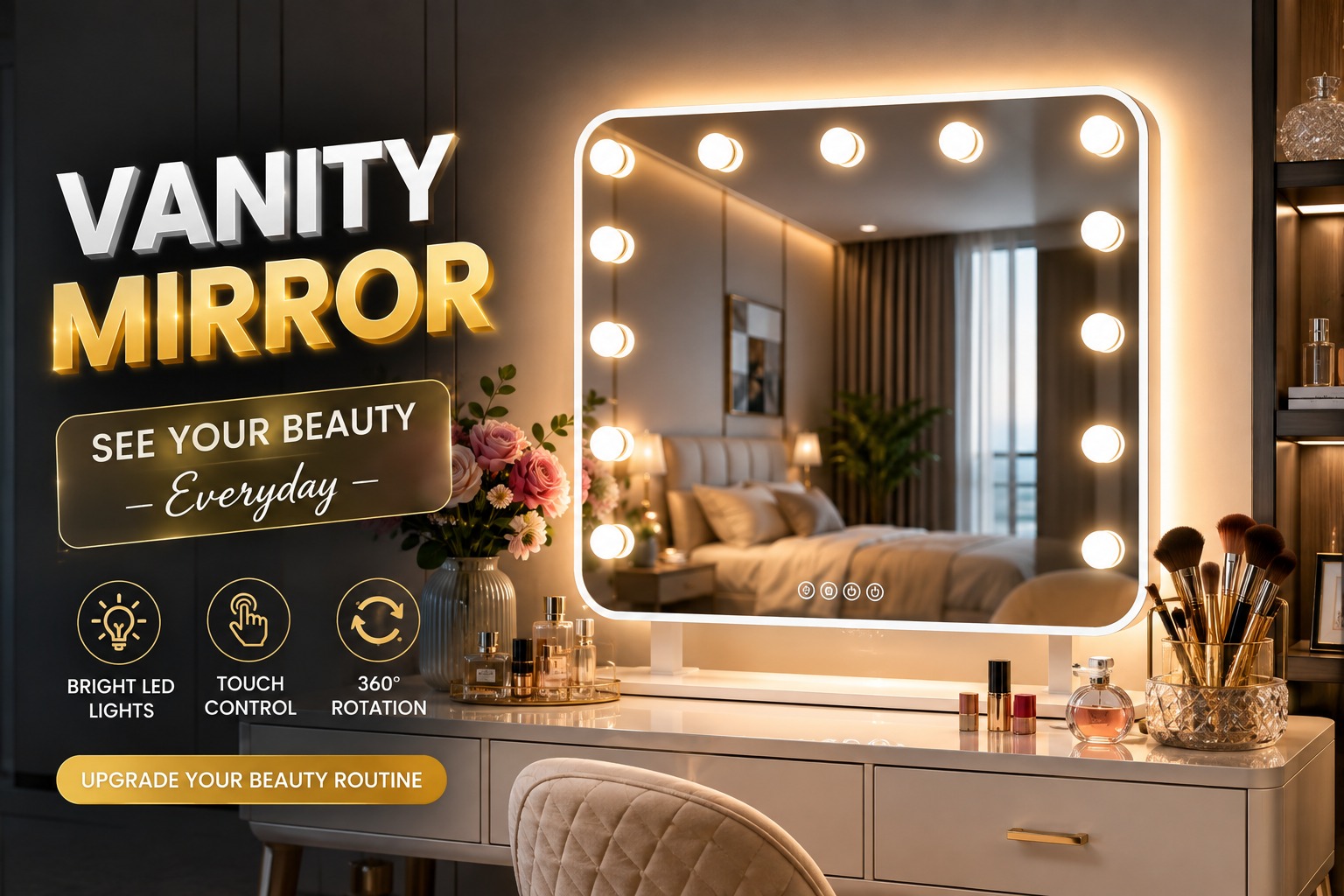
I still remember the morning I stood in my dimly lit bathroom, trying to blend foundation under a single overhead bulb that cast more shadows than light. My reflection looked tired, uneven, almost like a stranger. That day I finally bought a proper vanity mirror—one with soft, adjustable lighting and a clean, frameless edge. Within a week, my entire morning ritual felt different. Not dramatically better in some Instagram-ready way, but quietly more intentional. I could see what I was actually doing with my face instead of guessing.
That small upgrade taught me something most people overlook: a vanity mirror is not just another bathroom accessory. It is the surface where you meet yourself every day, often before coffee, before emails, before the rest of the world gets a vote. Choose poorly and you spend years fighting bad light and distorted angles. Choose well and the mirror becomes a quiet partner in how you present yourself and, more importantly, how you feel about what you see.
This article is for anyone who has ever squinted at a foggy reflection, bought a cheap lighted mirror that flickered after three months, or wondered why some people seem to nail their makeup every single time. We will look at what actually makes a vanity mirror useful, how different styles serve different lives, the practical details that separate the good ones from the frustrating ones, and the small habits that turn a mirror into something more than glass and light.
Why Lighting Matters More Than the Frame
Most people start shopping for a vanity mirror by looking at frames and finishes. That is the wrong place to begin. The single most important feature is light—its color temperature, its placement, and its consistency.
Natural daylight is the gold standard for accurate color. It is why makeup artists still prefer windows when they can get them. Indoors, the closest imitation comes from LED rings or strips that sit at roughly 5000–6500K. Warm bulbs (around 2700–3000K) flatter skin in the evening but hide redness and undertones. Cool, blue-heavy light makes everyone look slightly washed out. The best vanity mirror setups let you switch or at least choose a neutral range.
I once watched a friend apply contour under pure warm bathroom lighting. In the car later, under daylight, the contour looked like mud. She had been doing the same routine for years. A simple change to a dual-temperature vanity mirror fixed it in a week. The lesson sticks: if the light lies, everything that follows is a guess.
Placement matters almost as much as temperature. Lights that sit only above the mirror create under-eye shadows that exaggerate dark circles. Side lighting, ideally at eye level or slightly above, reduces those shadows and shows texture more honestly. Hollywood-style bulbs arranged around the perimeter remain popular for a reason—they wrap the face in relatively even illumination. Modern LED strips achieve the same effect with less heat and longer life.
Types of Vanity Mirrors and Who They Actually Serve
Not every vanity mirror belongs in every space. The market offers several distinct approaches, each with strengths and quiet limitations.
Wall-mounted lighted mirrors dominate small bathrooms. They free counter space and often include dimmers and color-temperature controls. The better ones are hardwired or use high-quality plug-in drivers that do not buzz. The cheaper versions develop dead LEDs within a year. If you rent, look for models with strong adhesive or temporary mounting systems that do not destroy tile.
Freestanding vanity mirrors with their own bases suit bedrooms or shared bathrooms where wall mounting is impossible. Many include magnification panels that swing out—usually 5x or 10x. The 10x versions are useful for brows and detailed work but can feel harsh if the main light is not balanced. I keep a 5x side panel on my own mirror and almost never use anything stronger; the distortion at 10x can make pores look like craters and lead to over-tweezing.
Portable and travel vanity mirrors have improved dramatically. The ones with rechargeable batteries and fold-out stands now last through a full week of hotel stays. The key is checking actual lumen output rather than trusting marketing photos. A dim travel mirror is worse than none at all because it trains you to work in compromised light.
Then there are the large, furniture-style vanity tables with integrated mirrors. These belong in dedicated dressing areas. They encourage a slower, more deliberate routine. The downside is footprint. In a small apartment they can feel like an indulgence that steals square footage from more practical needs. Still, for people who treat makeup or skincare as a genuine daily ritual, the dedicated surface changes behavior. You sit down. You take your time. The vanity mirror becomes part of a small ceremony rather than a rushed stop on the way out the door.
The Details That Separate Useful From Frustrating
After testing and living with more vanity mirrors than I care to admit, a few practical details repeatedly decide whether the piece stays or eventually migrates to a closet.
Glass quality is non-negotiable. Cheap mirrors introduce subtle distortion—straight lines that curve slightly near the edges, colors that shift depending on viewing angle. High-quality float glass or optical-grade mirrors keep reflections true. You notice the difference most when checking symmetry: left and right sides of the face should look consistent no matter where you stand.
Magnification should be optical, not digital. Some newer “smart” mirrors offer digital zoom through a camera and screen. The idea sounds convenient until you realize the latency and the way skin texture is processed by software. Traditional optical magnification still wins for accuracy.
Anti-fog coatings matter if the mirror lives near a shower. The best versions use a thin heated film or a specialized coating that resists condensation without needing constant wiping. I have owned both. The heated models cost more but remove one small daily annoyance that otherwise adds friction to the morning.
Dimmer quality is often overlooked. A smooth, continuous dimmer feels luxurious. Stepped or laggy controls feel cheap every single time you use them. If the mirror has memory for preferred brightness and color temperature, even better. Muscle memory is real; your hands should not have to renegotiate settings every morning.
Frame material and finish should match the room’s humidity and your cleaning habits. Brass and certain metals develop patina in steamy bathrooms. Powder-coated aluminum and quality plastics hold up longer with less maintenance. Matte black remains popular because it hides water spots better than high-gloss white.

Building a Routine Around the Mirror
Owning a good vanity mirror is only half the equation. How you use it determines whether it becomes a tool or just another surface that collects fingerprints.
Start by establishing consistent light. If your mirror offers multiple temperatures, pick one primary setting for makeup and stick with it most days. Occasional checks under warmer or cooler light help, but daily consistency trains your eye. Over time you stop second-guessing undertones.
Position yourself at a comfortable distance. Many people lean in too close, which exaggerates every pore and creates unnecessary tension in the neck and shoulders. A distance of roughly arm’s length for the main view, then closer only for detailed work, keeps posture better and judgment clearer.
Use the mirror for more than cosmetics. A few minutes of honest observation—skin texture, tension in the jaw, the set of the shoulders—can reveal patterns that no skincare product will fix on its own. I have caught myself clenching my jaw for weeks simply because the reflection made the habit visible. Small awareness compounds.
Clean the glass regularly with a proper glass cleaner and microfiber cloth. Residue from hairspray, foundation, and steam builds up faster than most people notice. A cloudy surface undermines even excellent lighting.
If you share the space, agree on preferred settings or use memory features if available. Shared vanity mirrors become sources of quiet irritation when one person prefers bright cool light and another prefers dim warm light. Clear habits reduce friction.
Common Mistakes and How to Avoid Them
The most frequent error is buying purely on aesthetics. A beautiful frame cannot compensate for poor light or distorted glass. Second is ignoring the room’s existing lighting. A vanity mirror that fights strong overhead LEDs or a large window will always feel compromised. Third is underestimating size. A tiny mirror forces constant head movement and incomplete views of the face and hairline. Measure the space and give the mirror enough real estate to be useful.
Another quiet mistake is treating the vanity mirror as a permanent fixture that never needs evaluation. Light sources degrade. Coatings wear. Preferences change. Every couple of years it is worth assessing whether the current setup still serves the way you actually live.
The Subtle Psychology of Seeing Yourself Clearly
There is a reason people still gather around dressing tables in films and novels. The act of sitting or standing in front of a dedicated mirror creates a small boundary between the private self and the public one. In a world of constant digital reflection—selfies, video calls, filtered images—an honest, well-lit vanity mirror offers something rarer: a moment of relatively unmediated seeing.
That does not mean the mirror is neutral. Lighting still shapes mood. A soft, flattering setup can make difficult mornings feel more manageable. Harsh, clinical light can sharpen focus when precision matters. The goal is not perfection or constant self-critique. It is simply enough clarity to make deliberate choices about how you show up.
I have noticed that people who maintain a thoughtful vanity mirror setup often develop quieter confidence in their appearance. Not because the mirror flatters them into delusion, but because they stop fighting poor information. They know what their skin looks like under consistent conditions. They know which products actually work. The daily negotiation becomes less dramatic.
Choosing and Living With Your Vanity Mirror
If you are in the market, begin with light quality and placement, then move to size and mounting style, then to secondary features like magnification and anti-fog. Read real user reviews that mention longevity rather than unboxing excitement. Prefer brands that publish actual color-temperature ranges and lumen figures instead of vague claims of “professional lighting.”
Once the mirror is installed, give yourself a short adjustment period. Old habits of leaning in, tilting the head, or working under residual bad light take time to fade. After a few weeks the new setup should feel ordinary rather than special—which is exactly the point. Tools that work well disappear into the background of competent daily life.
A vanity mirror will never solve deeper questions of self-image or confidence. It can, however, remove unnecessary friction from the moments when you prepare to meet the day. In a life already full of compromise and imperfect light, that small reliability is worth protecting.
The next time you stand in front of yours, notice the quality of the light, the honesty of the reflection, and the small decisions that follow. Those decisions accumulate. Over months and years they shape how you move through the world. A well-chosen vanity mirror does not create that process, but it can make the process clearer, calmer, and more your own.